
17 May Varicocele and Male Fertility: Causes, Diagnosis and Treatment
Table of Contents
Varicocele and male fertility are two terms that every man facing fertility challenges should understand — because varicocele is the single most common correctable cause of male infertility, found in approximately 15% of all men and up to 35–40% of men being evaluated for infertility. Despite its prevalence, varicocele and male fertility connections remain underappreciated and underdiagnosed in many clinical settings.
At Fertibless Clinic in Delhi, Dr. Shipra Gupta includes scrotal ultrasound and male fertility evaluation in every couple’s infertility workup — because addressing varicocele can sometimes be the single most impactful intervention available.
What Is a Varicocele?
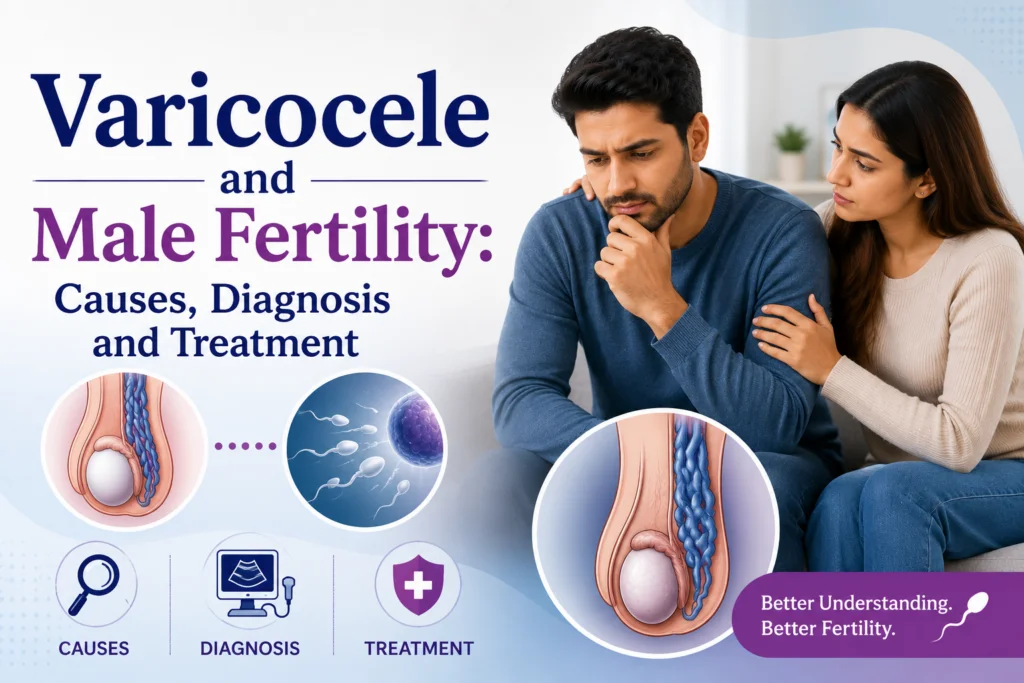
A varicocele is an abnormal enlargement of the pampiniform plexus — the network of veins that drain blood from the testes. Think of it as varicose veins in the scrotum. The left testis is affected in approximately 90% of cases, due to the angle at which the left testicular vein drains into the renal vein. Bilateral varicocele (affecting both testes) occurs in approximately 10% of cases.
Varicoceles develop when the valves within the testicular veins fail, allowing blood to pool and flow backwards — a process called venous reflux. The resulting blood pooling raises the temperature of the testicular environment, which is normally kept 2–4°C below core body temperature for optimal sperm production.
How Varicocele Damages Male Fertility
The varicocele and male fertility relationship is driven by several harmful mechanisms that impair sperm production and quality:
- Heat: Elevated scrotal temperature — The most central mechanism. Spermatogenesis requires a temperature below core body temperature. Pooled, warm venous blood from varicocele raises scrotal temperature and disrupts sperm production directly.
- Oxidative Stress: Oxidative stress — Varicocele significantly increases reactive oxygen species (ROS) in the testicular environment. This oxidative damage impairs sperm motility, morphology, and DNA integrity — raising sperm DNA fragmentation.
- Hormones: Hormonal disruption — Chronic venous stasis affects Leydig cell function, potentially reducing testosterone production and impairing the hormonal drive for spermatogenesis.
- Toxins: Venous reflux of toxic metabolites — Retrograde blood flow from the adrenal and renal veins may carry metabolic byproducts (including cortisol and catecholamines) that are directly toxic to testicular tissue.
- Progression: Progressive testicular damage — Varicocele causes ongoing, cumulative damage to the testes over time. Men with untreated varicocele show progressive decline in semen parameters year on year — making varicocele and male fertility a time-sensitive concern.
For couples where the male partner has both varicocele and severely impaired sperm production, our article on azoospermia treatment explains the full range of surgical sperm retrieval options available.
Symptoms and Clinical Grading of Varicocele
Varicocele is often asymptomatic — discovered only during fertility evaluation. When symptoms do occur, they include:
- A dull, aching pain or heaviness in the scrotum — typically worse after prolonged standing or physical activity.
- A visible or palpable ‘bag of worms’ sensation in the upper scrotum.
- Testicular atrophy — the affected testis may appear or feel smaller than normal.
Clinical grading of varicocele is based on physical examination:
- Grade I — Palpable only during Valsalva manoeuvre (bearing down). Subclinical varicocele (detected only on Doppler ultrasound) falls below this.
- Grade II — Palpable at rest without Valsalva.
- Grade III — Visible through the scrotal skin without palpation.
Diagnosing Varicocele and Its Impact on Male Fertility
Diagnosis of varicocele and its impact on male fertility involves:
- Physical examination — by an experienced clinician. Clinical varicoceles (Grades I–III) are the standard for treatment decisions.
- Scrotal Doppler ultrasound — the most sensitive tool for detecting and grading varicocele and male fertility impact. Measures venous dilation and retrograde blood flow.
- Comprehensive semen analysis — evaluates the effect of varicocele on sperm count, motility, and morphology. Classic varicocele findings include ‘stress pattern’ — tapered or stressed spermatozoa — alongside reduced motility.
- Sperm DNA fragmentation test — elevated DFI is a hallmark finding in varicocele-related male infertility. Varicocele repair consistently improves DFI in published studies.
- Hormone testing — FSH, LH, testosterone, and prolactin to evaluate the hormonal consequences of varicocele on spermatogenesis.
For couples with combined male and female infertility factors, our article on unexplained infertility causes discusses how multiple overlapping factors — including varicocele — are investigated together.
Varicocele Treatment Options and Male Fertility Outcomes
Varicocelectomy — Surgical Repair
Microsurgical varicocelectomy — performed through a small incision in the groin using an operating microscope — is the gold standard varicocele and male fertility treatment. The affected veins are ligated while preserving the testicular artery and lymphatics. Success rates are high:
- Semen parameters improve in approximately 60–70% of men after microsurgical varicocelectomy.
- Natural conception rates improve significantly in couples where female partner fertility is normal.
- Sperm DNA fragmentation decreases substantially after varicocele repair — often normalising within 3–6 months.
- IVF success rates improve when varicocelectomy is performed before an IVF cycle in couples with varicocele-related male infertility.
Varicocele Embolisation
A minimally invasive, radiologically guided procedure in which the varicocele veins are blocked using coils or sclerosing agents. Comparable improvement in semen parameters to surgery, with a shorter recovery period.
IVF/ICSI Without Surgical Repair
For couples where IVF is planned regardless — or where female fertility factors require immediate assisted conception — proceeding directly to IVF with ICSI may be the most time-efficient approach. The question of whether to repair the varicocele first or proceed to IVF is a shared decision between the couple and their specialist.
| Expert Insight — Dr. Shipra Gupta Varicocele and male fertility is one of the most hopeful areas of male infertility treatment — because unlike many causes of poor sperm quality, varicocele is both diagnosable and treatable. I always examine and scan the male partner when a couple comes to Fertibless. If a significant varicocele is found alongside reduced semen parameters and high sperm DNA fragmentation, treating the varicocele before an IVF cycle can meaningfully change the outcome. Three months after repair, semen parameters are often dramatically different — and sometimes couples who thought they needed IVF are able to conceive naturally. — Dr. Shipra Gupta, Infertility Specialist, Fertibless Clinic, Delhi |
Reference: American Urological Association — www.auanet.org | ASRM Male Infertility Guidelines — www.asrm.org | NIH PubMed — PubMed
Frequently Asked Questions
Does every man with a varicocele need treatment?
No. Subclinical varicocele (detected only on ultrasound with no physical findings) is not generally treated for fertility purposes. Grade I–III clinical varicocele is considered for treatment when semen parameters are abnormal and the couple has documented infertility. A varicocele found incidentally in a man with normal semen analysis may not require intervention.
How long after varicocele treatment does sperm quality improve?
Semen parameters begin improving within 3 months after varicocelectomy or embolisation — aligned with the 72–90 day sperm production cycle. Maximum improvement is typically seen at 6 months post-treatment. A repeat semen analysis at 3 and 6 months after treatment monitors recovery.
Can varicocele cause azoospermia?
Does every man with a varicocele need treatment?
No. Subclinical varicocele (detected only on ultrasound with no physical findings) is not generally treated for fertility purposes. Grade I–III clinical varicocele is considered for treatment when semen parameters are abnormal and the couple has documented infertility. A varicocele found incidentally in a man with normal semen analysis may not require intervention.
Is varicocele associated with recurrent pregnancy loss?
Emerging evidence suggests that high sperm DNA fragmentation from varicocele may contribute to recurrent early pregnancy loss in couples where female partner investigations are normal. Varicocele repair has been shown to reduce DNA fragmentation and may improve pregnancy maintenance in these couples.
Can lifestyle changes treat varicocele?
Lifestyle changes — antioxidants, avoiding heat, stopping smoking — can reduce oxidative damage caused by varicocele and may modestly improve semen parameters. However, they do not correct the underlying venous anatomy. For significant varicocele with meaningful impact on semen quality, physical treatment (surgery or embolisation) is required.
| Concerned about varicocele and male fertility? Consult Dr. Shipra Gupta at Fertibless Clinic, Delhi for a complete male fertility evaluation. Book your consultation today. |

Dr. Shipra Gupta is a renowned obstetrician, gynaecologist, and infertility specialist, boasting over 17 years of invaluable clinical, teaching, and research experience. She has successfully performed more than 1200 cycles of IUI, IVF, natural cycle IVF, donor egg, and FET cycles. Dr. Gupta specializes in managing complex cases involving Advanced Maternal Age, PCO, Poor Ovarian Reserve, endometriosis, and unexplained infertility. Her expertise extends to treating recurrent IVF failures and male infertility.