
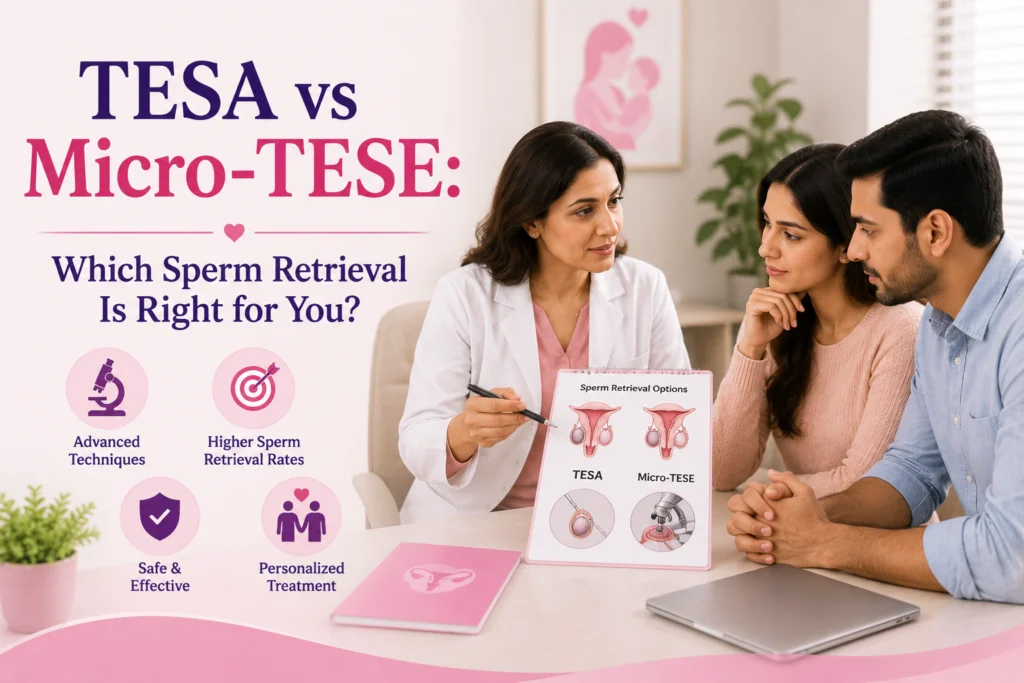
29 Jun TESA vs Micro-TESE: Which Sperm Retrieval Is Right for You?
Table of Contents
Hearing the word “azoospermia” no sperm in the ejaculate is one of the most difficult moments a man and his partner can face. It can feel like the end of the road. But for many men, it is not.
TESA vs Micro-TESE: these two surgical sperm retrieval procedures have helped thousands of men with azoospermia become biological fathers. Understanding the difference and which one is right for your diagnosis is the first step toward a clearer path forward.
What Is Azoospermia?
Azoospermia is the complete absence of sperm in the ejaculate. It affects approximately 1% of all men and up to 10–15% of men who are infertile. There are two types:
- Obstructive Azoospermia (OA): Sperm is produced normally but cannot reach the ejaculate due to a blockage — from a prior vasectomy, infection, or congenital absence of the vas deferens.
- Non-Obstructive Azoospermia (NOA): The testes produce little or no sperm due to hormonal imbalances, genetic factors, or testicular failure.
Quick Answer: TESA (Testicular Sperm Aspiration) uses a needle to extract sperm from the testicle and is best for obstructive azoospermia. Micro-TESE (Microsurgical Testicular Sperm Extraction) involves open surgery under a microscope to find sperm in men with non-obstructive azoospermia. Both procedures are used with IVF and ICSI to help men with azoospermia have biological children.
What Is TESA?
TESA (Testicular Sperm Aspiration) is a minimally invasive procedure in which a fine needle is inserted into the testicle under local anaesthesia to aspirate sperm or testicular tissue.
Key features of TESA:
- Performed under local anaesthesia
- Takes approximately 10–15 minutes
- Minimal recovery time — most men return to normal activity within 24–48 hours
- Best suited for men with obstructive azoospermia (vasectomy, blockage)
- Sperm retrieved can be used fresh or frozen for future ICSI cycles
According to Johns Hopkins Medicine, TESA is the most straightforward sperm retrieval option and is highly effective when there is a known obstruction.
What Is Micro-TESE?
Micro-TESE (Microsurgical Testicular Sperm Extraction) is an open surgical procedure in which the testicle is opened and examined under a high-powered operating microscope — up to 25x magnification — to identify and extract sperm-producing tubules.
Key features of Micro-TESE:
- Performed under general anaesthesia
- Takes 1–2 hours
- Requires 2–3 days of recovery and temporary scrotal swelling
- Best suited for men with non-obstructive azoospermia
- First-time Micro-TESE sperm retrieval rates for NOA reach approximately 40–65% depending on the underlying cause
TESA vs Micro-TESE — Side-by-Side Comparison
| Feature | TESA | Micro-TESE |
| Anaesthesia | Local | General |
| Invasiveness | Needle aspiration | Open surgical |
| Best for | Obstructive azoospermia | Non-obstructive azoospermia |
| Procedure time | 10–15 mins | 60–120 mins |
| Recovery | 24–48 hours | 2–3 days |
| Sperm yield | High (when OA confirmed) | Variable (40–65% success rate) |
| Used with | IVF + ICSI | IVF + ICSI |
What Happens to Retrieved Sperm?
Whether sperm is obtained through TESA or Micro-TESE, it must be used with IVF and ICSI — where a single sperm is injected directly into the egg under a microscope. The retrieved sperm can be used immediately or cryopreserved (frozen) for future cycles.
If no sperm is found during the procedure, the fertility team will discuss options including a repeat attempt, a different retrieval technique, or donor sperm — giving couples time to consider their path forward with full support.
Expert Insight — Dr. Shipra Gupta, Fertibless Clinic
“When a man is told he has azoospermia, the couple often feels the journey is over. My message is always: let us first find out why. The type of azoospermia — obstructive or non-obstructive — completely changes what is possible. With the right procedure and a personalised IVF plan, many of these couples have gone on to hold their own child.”
— Dr. Shipra Gupta, Infertility Specialist, Fertibless Clinic, New Delhi
Frequently Asked Questions
Is TESA or Micro-TESE more painful?
TESA uses local anaesthesia and causes minimal discomfort — most men describe mild soreness for a day or two. Micro-TESE is performed under general anaesthesia, so the procedure is painless, but recovery involves more swelling and discomfort, typically managed with oral medication.
Which procedure has a higher sperm retrieval success rate?
For obstructive azoospermia, TESA has very high success rates. For non-obstructive azoospermia, Micro-TESE is significantly more effective, with sperm found in approximately 40–65% of cases.
Can sperm retrieved via TESA or Micro-TESE be frozen?
Yes. Sperm can be cryopreserved and used in future IVF-ICSI cycles, which is particularly useful if the female partner’s retrieval is scheduled separately.
What if no sperm is found during Micro-TESE?
The couple is counselled about options including a second attempt after recovery, or alternative family-building pathways such as donor sperm. This is discussed with full compassion and no pressure.

Dr. Shipra Gupta is a renowned obstetrician, gynaecologist, and infertility specialist, boasting over 17 years of invaluable clinical, teaching, and research experience. She has successfully performed more than 1200 cycles of IUI, IVF, natural cycle IVF, donor egg, and FET cycles. Dr. Gupta specializes in managing complex cases involving Advanced Maternal Age, PCO, Poor Ovarian Reserve, endometriosis, and unexplained infertility. Her expertise extends to treating recurrent IVF failures and male infertility.