
05 May Sperm DNA Fragmentation: What It Means and How to Treat It
Table of Contents
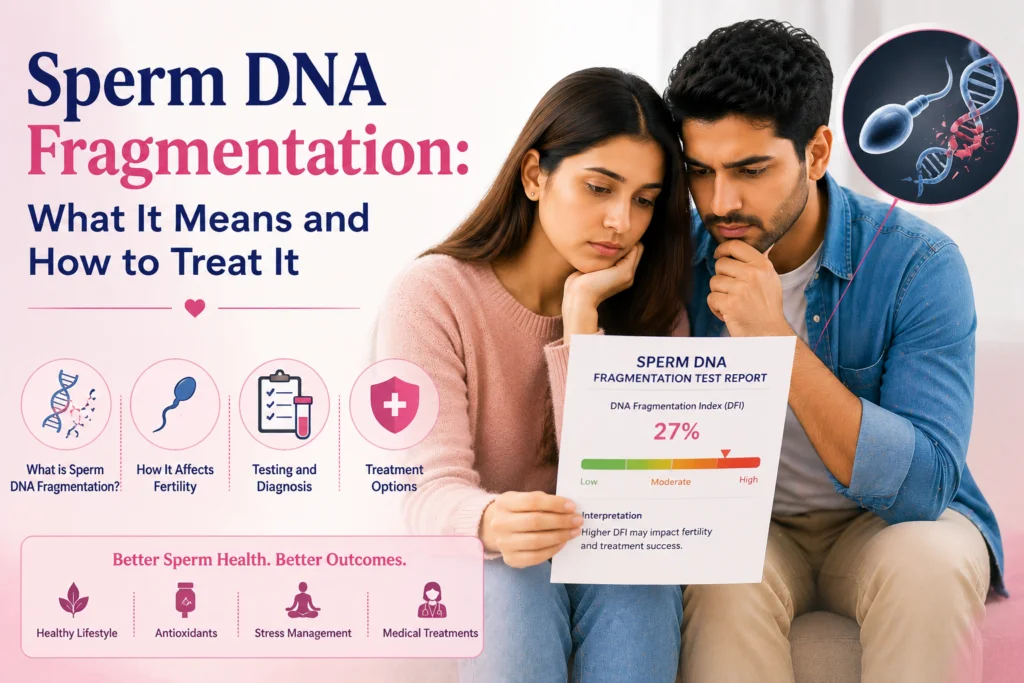
Sperm DNA fragmentation is one of the most significant and most underdiagnosed causes of male infertility, recurrent IVF failure, and pregnancy loss. Unlike standard semen analysis, which evaluates sperm count, motility, and shape. It measures the integrity of the genetic material carried inside each sperm cell. A man can have a perfectly normal semen analysis result and still have high sperm DNA fragmentation which is why this test is critical for couples who have experienced failed IVF cycles or repeated pregnancy loss.
At Fertibless Clinic in Delhi, we offered as part of the advanced male fertility evaluation because Dr. Shipra Gupta understands that standard testing alone does not tell the full story.
What Is Sperm DNA Fragmentation?
Sperm DNA fragmentation refers to breaks or damage in the strands of DNA within the sperm’s genetic material. Every sperm carries half the genetic blueprint needed to create a new life — and the integrity of that genetic material is critical for normal fertilisation, embryo development, and a healthy pregnancy.
It is measured using the DNA Fragmentation Index (DFI) — the percentage of sperm in a sample showing significant DNA damage:
- Good: DFI below 15% — Low fragmentation. Good fertilisation and embryo development expected.
- Moderate: DFI 15–25% — Moderate fragmentation. May affect embryo development and implantation rates.
- High: DFI above 25% — High fragmentation. Associated with significantly reduced IVF success, poor embryo quality, and higher rates of miscarriage.
- Very High: DFI above 30% — Very high fragmentation. Surgical sperm retrieval or other interventions may be recommended.
How Sperm DNA Fragmentation Causes Fertility Problems
It damages fertility at multiple stages of the conception process:
- Fertilisation failure — Heavily fragmented DNA may prevent a sperm from successfully activating the egg after penetration, causing fertilisation to fail even with good sperm counts.
- Poor embryo development — Embryos created with high sperm DNA fragmentation often show arrested development or poor blastocyst formation — the same pattern seen in unexplained IVF failures.
- Implantation failure — Even if fertilisation and early development occur, damaged DNA in the embryo can prevent successful implantation in the uterine lining.
- Recurrent pregnancy loss — it is recognised as a cause of recurrent pregnancy loss in couples where standard investigations are normal. The embryo implants but carries genetic damage that prevents healthy development.
If you have experienced unexplained IVF failures, read our detailed guide on unexplained infertility causes, which explains why standard tests miss sperm DNA fragmentation — and what advanced investigations can reveal.
Causes of High Sperm DNA Fragmentation
- Oxidative stress — The most common cause. Free radicals from smoking, alcohol, pollution, heat exposure, and poor diet damage sperm DNA during maturation in the epididymis.
- Varicocele — Varicose veins in the scrotum increase local temperature and oxidative damage, significantly raising its levels.
- Infection and inflammation — Genital tract infections generate inflammatory free radicals that directly damage sperm DNA.
- Chemotherapy and radiation — Both are directly genotoxic to sperm, causing substantial sperm DNA fragmentation that may persist for months or years.
- Age — Male fertility is not immune to the effects of ageing. it increases with age, contributing to reduced success rates in older couples.
- Tight clothing and heat — Elevated scrotal temperature impairs sperm maturation and worsens sperm DNA fragmentation over time.
Sperm DNA Fragmentation Testing — What to Expect
At Fertibless Clinic, testing is performed alongside a full semen analysis. The most commonly used test methods are the TUNEL assay and SCSA (Sperm Chromatin Structure Assay), both of which measure DFI and provide a reliable, reproducible result.
The test is recommended for: men with two or more failed IVF cycles despite good embryo quality, couples with recurrent pregnancy loss and no other identified cause, men with normal semen analysis but unexplained infertility, and men with a history of cancer treatment, varicocele, or chronic infection.
For couples investigating recurrent pregnancy loss, this should be part of the male partner’s workup alongside standard semen analysis — because it is one of the most commonly missed male contributors to repeated miscarriage.
Sperm DNA Fragmentation Treatment Options
- Antioxidants: Antioxidant supplementation — Vitamin C, vitamin E, selenium, CoQ10, and lycopene reduce oxidative stress and may significantly lower sperm DNA fragmentation over 3–6 months.
- Lifestyle: Lifestyle changes — Stopping smoking, eliminating alcohol, reducing heat exposure, and achieving a healthy weight all reduce oxidative damage and improve scores.
- Varicocele: Varicocele repair — Surgical treatment of a clinically significant varicocele can substantially improve in affected men, sometimes normalising DFI within 3–6 months.
- Infection: Antibiotic and anti-inflammatory treatment — Where genital tract infection or inflammation is contributing, targeted treatment reduces inflammatory free radicals and may improve it.
- Surgical: Testicular sperm retrieval (TESA) — Sperm retrieved directly from the testis carries significantly less DNA damage than ejaculated sperm, because epididymal transit — where most oxidative damage accumulates — is bypassed. For men with very high sperm DNA fragmentation, TESA with ICSI is the most effective sperm DNA fragmentation treatment pathway.
For men with severe sperm DNA fragmentation and very low or absent sperm, our detailed guide on azoospermia treatment covers surgical retrieval options including TESA and Micro-TESE in detail.
| Expert Insight — Dr. Shipra Gupta Sperm DNA fragmentation is the invisible factor in many of the most frustrating fertility cases I see. A couple walks in with normal semen analysis, normal ovarian reserve, good embryos on IVF embryo grading — and yet transfers keep failing. It is often the missing piece. I now test for it routinely in any couple with two or more failed cycles, and the results frequently change the entire treatment plan. Testicular sperm retrieval for high-DFI patients has genuinely transformed outcomes for several couples at Fertibless who had almost given up hope. — Dr. Shipra Gupta, Infertility Specialist, Fertibless Clinic, Delhi |
Reference: American Society for Reproductive Medicine — www.asrm.org | European Society of Human Reproduction and Embryology — www.eshre.eu | NIH PubMed — PubMed
Frequently Asked Questions
Can sperm DNA fragmentation be reversed?
Yes — in many cases. Lifestyle changes, antioxidant supplementation, and treatment of underlying causes such as varicocele can meaningfully reduce it over 3–6 months.
Does it cause miscarriage?
Yes. High sperm DNA fragmentation is independently associated with increased miscarriage risk — even in couples where the female partner’s investigations are entirely normal.
Is sperm DNA fragmentation tested in a standard semen analysis?
No. A standard semen analysis measures count, motility, and morphology — not DNA integrity. Sperm DNA fragmentation requires a separate, specialised test (TUNEL assay or SCSA).
How long does it take to improve sperm with antioxidants?
Sperm takes approximately 72–90 days to mature fully. This means antioxidant supplementation and lifestyle changes need at least 3 months of consistent application before a repeat test will reflect improvement. Planning any IVF cycle around this timeline is strongly recommended.
Does ICSI avoid the problem of sperm DNA fragmentation?
Not entirely. ICSI selects a single sperm for injection but cannot currently screen for DNA integrity at the point of selection. If sperm DNA fragmentation is very high, the selected sperm may still carry damaged DNA. TESA — retrieving sperm directly from the testis — is a more effective solution because testicular sperm carries significantly less DNA fragmentation than ejaculated sperm.
| Concerned about sperm? Consult Dr. Shipra Gupta at Fertibless Clinic, Delhi for a comprehensive male fertility evaluation including sperm testing. |

Dr. Shipra Gupta is a renowned obstetrician, gynaecologist, and infertility specialist, boasting over 17 years of invaluable clinical, teaching, and research experience. She has successfully performed more than 1200 cycles of IUI, IVF, natural cycle IVF, donor egg, and FET cycles. Dr. Gupta specializes in managing complex cases involving Advanced Maternal Age, PCO, Poor Ovarian Reserve, endometriosis, and unexplained infertility. Her expertise extends to treating recurrent IVF failures and male infertility.