
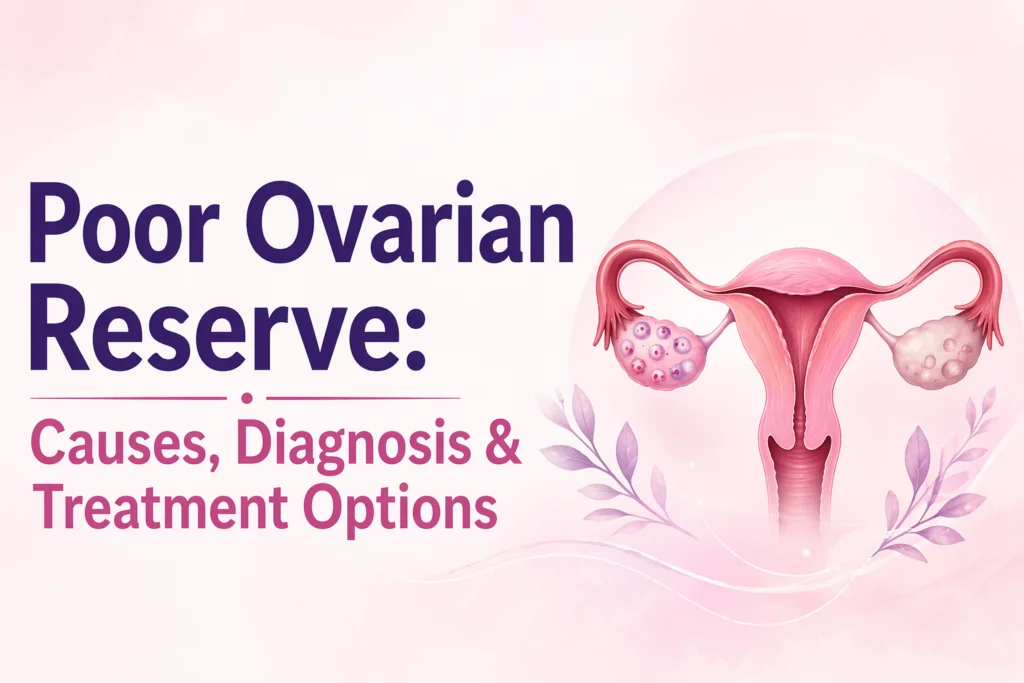
01 Apr Poor Ovarian Reserve: Causes, Diagnosis & Treatment Options
Table of Contents
Poor ovarian reserve treatment is the first thing many women search for after receiving one of the most emotionally challenging diagnoses in fertility medicine. Being told your ovarian reserve is low can feel like the ground has shifted beneath you — raising immediate fears about your chances of becoming a mother. But here is what you need to know: poor ovarian reserve does not mean the end of your journey.
With the right approach to poor ovarian reserve treatment, many women go on to achieve successful pregnancies — through personalised IVF protocols, Natural Cycle IVF, Donor Egg IVF, or a combination of targeted lifestyle and medical strategies. At Fertibless Clinic in Delhi, Dr. Shipra Gupta has guided hundreds of women with low ovarian reserve toward parenthood through evidence-based, compassionate care.
What Is Ovarian Reserve?
Ovarian reserve refers to the number and quality of eggs remaining in a woman’s ovaries. Every woman is born with a finite supply of eggs — approximately 1–2 million at birth — and this reserve declines continuously throughout life. When it diminishes faster than expected for a woman’s age, it is diagnosed as diminished or poor ovarian reserve (DOR).
Poor ovarian reserve does not necessarily prevent natural conception, but it does mean fewer eggs are available for fertility treatment — which can reduce the response to stimulation and the number of embryos obtained in an IVF cycle.
Common Causes of Poor Ovarian Reserve
Understanding why poor ovarian reserve occurs is the first step toward choosing the right poor ovarian reserve treatment approach:
- Advancing age — The most common cause. Reserve declines naturally and accelerates after age 35.
- Genetic conditions — Turner syndrome, Fragile X premutation, and other chromosomal variants can cause early depletion.
- Autoimmune disorders — The immune system may mistakenly target ovarian tissue, reducing follicular supply.
- Previous ovarian surgery — Cystectomy or removal of endometriomas can inadvertently remove healthy ovarian tissue.
- Cancer treatment — Chemotherapy and pelvic radiation are well-documented causes of ovarian damage.
- Endometriosis — Directly affects ovarian tissue, reducing both reserve and egg quality.
- Lifestyle and environmental factors — Smoking, toxin exposure, and chronic stress may accelerate follicular decline.
In some cases, no clear cause is identified (idiopathic DOR). This does not change the approach to poor ovarian reserve treatment.
How Poor Ovarian Reserve Is Diagnosed
Accurate diagnosis is essential before selecting the most appropriate poor ovarian reserve treatment. Diagnosis involves a combination of blood tests and ultrasound assessment:
- AMH: Anti-Mullerian Hormone (AMH) — AMH is produced by small follicles and is the most reliable single marker of ovarian reserve. A level below 1.0 ng/mL typically indicates poor reserve.
- AFC: Antral Follicle Count (AFC) — A transvaginal ultrasound counts the small resting follicles visible in both ovaries. An AFC below 5–7 is associated with poor response to stimulation.
- FSH: Follicle-Stimulating Hormone (FSH) on Day 2–3 — Elevated FSH (above 10 mIU/mL) suggests the ovaries are working harder to respond to the brain’s signals, indicating diminished reserve.
- Estradiol: Estradiol (E2) — Elevated early-cycle estradiol alongside high FSH further confirms poor reserve.
No single test is conclusive on its own. Dr. Shipra Gupta evaluates all markers together alongside the patient’s age and clinical history to determine the most appropriate poor ovarian reserve treatment plan.
Poor Ovarian Reserve Treatment Options That May Help
While poor ovarian reserve cannot be reversed, several evidence-supported poor ovarian reserve treatment strategies may significantly improve outcomes:
IVF with Individualised Stimulation Protocols
Standard high-dose stimulation is often counterproductive for women with poor ovarian reserve. Instead, a tailored protocol — such as a modified antagonist cycle or mini-IVF — is designed to optimise the quality of eggs retrieved rather than simply aiming for maximum quantity. At Fertibless Clinic, stimulation protocols are customised to each woman’s specific reserve markers and previous cycle response.
Natural Cycle IVF
For women with very low reserve who respond minimally to stimulation, Natural Cycle IVF works with the body’s natural monthly cycle — collecting the single egg produced without heavy medication. This approach preserves egg quality and avoids the risk of overstimulation, making it a valuable poor ovarian reserve treatment option for carefully selected patients.
Donor Egg IVF
When ovarian reserve is critically depleted — or when previous stimulated cycles have yielded no usable eggs — Donor Egg IVF offers the highest success rates. Using eggs from a healthy, thoroughly screened donor combined with the partner’s sperm bypasses the reserve limitation entirely. Many women find this pathway deeply meaningful, and success rates reflect the donor’s age and egg quality rather than the recipient’s reserve.
Supplements That May Support Egg Quality
These supplements are commonly discussed as supportive additions to poor ovarian reserve treatment. Always consult Dr. Shipra Gupta before starting any supplement:
- Coenzyme Q10 (CoQ10) — May support mitochondrial energy production within follicles, potentially improving egg quality. Doses studied typically range from 200–600 mg daily, started 3 months before egg retrieval.
- DHEA — Some evidence suggests it may improve ovarian response in poor responders when used under specialist supervision.
- Melatonin — An antioxidant naturally found in follicular fluid; may protect developing eggs from oxidative damage.
- Vitamin D — Deficiency is linked to reduced fertility; tested and supplemented as appropriate under guidance.
- Folic acid / Methylfolate — Essential for DNA health and cell division; recommended for all women trying to conceive.
| Expert Insight — Dr. Shipra Gupta Poor ovarian reserve treatment is one of the most nuanced areas of fertility care. There is no universal protocol that works for every woman. What matters most is understanding each patient’s unique profile — her AMH, her AFC, how she has responded to stimulation previously, her age, and her priorities. Sometimes a modified IVF protocol is the answer; sometimes Natural Cycle IVF is more appropriate; sometimes, after a full conversation, donor eggs are the most loving and practical path forward. I have seen women with AMH under 0.5 ng/mL achieve healthy pregnancies — and I have helped others find equal joy through donor eggs. The journey looks different for everyone. — Dr. Shipra Gupta, Infertility Specialist, Fertibless Clinic, Delhi |
Lifestyle Factors That May Support Poor Ovarian Reserve Treatment
These changes, ideally made 3 months before egg retrieval, may positively influence the quality of remaining eggs:
- Quit smoking — Directly toxic to follicles and one of the most impactful changes a woman can make for her reproductive health.
- Maintain a healthy body weight — Both underweight and overweight status disrupt hormonal balance relevant to ovarian function.
- Reduce alcohol — Associated with reduced egg quality and poorer IVF outcomes.
- Manage chronic stress — Sustained cortisol elevation can interfere with the hormonal signalling required for follicular development.
- Prioritise sleep — Deep sleep supports growth hormone secretion and melatonin production, both relevant to follicular health.
- Anti-inflammatory diet — A Mediterranean-style diet rich in vegetables, healthy fats, and omega-3s supports the overall hormonal environment.
When to Seek Poor Ovarian Reserve Treatment
If you are under 35 and have been trying to conceive for 12 months without success, it is time to consult a fertility specialist. If you are over 35, this threshold drops to 6 months. If you have a known risk factor for low reserve — such as previous ovarian surgery, a family history of early menopause, cancer treatment, or suspected endometriosis — earlier evaluation is strongly recommended.
Ovarian reserve only declines with time. Seeking poor ovarian reserve treatment early preserves the most options — and gives you and your specialist the widest possible range of strategies to explore.
Reference: For more on ovarian reserve and reproductive health guidelines, see the American Society for Reproductive Medicine (ASRM) at www.asrm.org and the WHO Reproductive Health Library.
Frequently Asked Questions
Can I get pregnant naturally with poor ovarian reserve?
It is possible, though challenging. Women with low reserve still ovulate — it may just be less predictable. However, natural conception becomes progressively more difficult as reserve declines, which is why early evaluation and treatment are so important.
What is a low AMH level?
AMH below 1.0 ng/mL is generally considered low for reproductive purposes, though interpretation depends on age. A woman aged 38 with AMH of 0.8 ng/mL is in a different clinical situation than a 28-year-old with the same level. Always discuss results with your doctor in context.
Does poor ovarian reserve mean I will go into early menopause?
Not necessarily. Low AMH indicates fewer remaining eggs but does not reliably predict the timing of menopause, which is influenced by many genetic and environmental factors.
Is Donor Egg IVF legal in India?
Yes. Donor Egg IVF is legally permitted in India under the Assisted Reproductive Technology (Regulation) Act, 2021, with appropriate donor screening and documentation.
Can supplements improve my AMH levels?
Research is ongoing, but supplements like DHEA and CoQ10 may improve egg quality and ovarian response in some women — though they are unlikely to significantly raise AMH. Always consult your specialist before starting any supplement.
How many IVF cycles should I try with poor ovarian reserve?
This depends on how many eggs are retrieved, embryo quality, age, and other factors. Your fertility specialist will review your response after each cycle and discuss whether to continue, adjust the protocol, or explore other options.

Dr. Shipra Gupta is a renowned obstetrician, gynaecologist, and infertility specialist, boasting over 17 years of invaluable clinical, teaching, and research experience. She has successfully performed more than 1200 cycles of IUI, IVF, natural cycle IVF, donor egg, and FET cycles. Dr. Gupta specializes in managing complex cases involving Advanced Maternal Age, PCO, Poor Ovarian Reserve, endometriosis, and unexplained infertility. Her expertise extends to treating recurrent IVF failures and male infertility.