
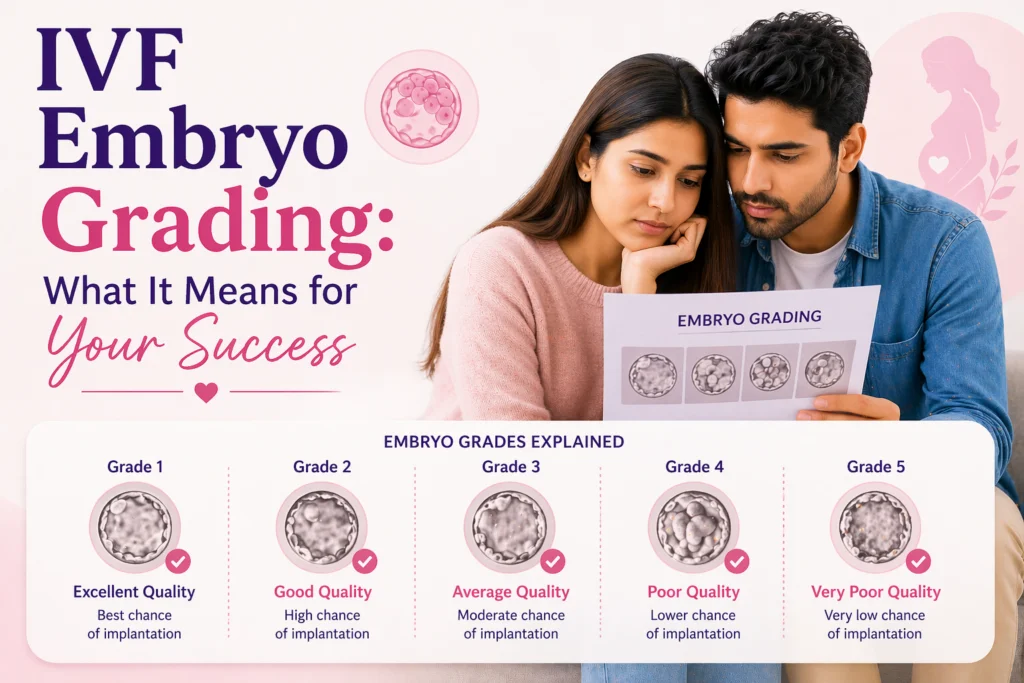
20 Apr IVF Embryo Grading: What It Means for Your Success
Table of Contents
IVF embryo grading is one of the most important — and most misunderstood — parts of the entire IVF process. When you receive the call from your clinic with your embryo update, you may hear terms like ‘4-cell grade 1’ or ‘blastocyst 4AA’ and wonder what any of it means for your chances. Understanding IVF embryo grading clearly can help you make sense of your cycle and approach transfer day with realistic, informed expectations.
At Fertibless Clinic in Delhi, Dr. Shipra Gupta and her experienced embryology team guide patients through every step of IVF embryo grading with full transparency — because you deserve to understand exactly what is happening with your embryos at each stage of development.
Why IVF Embryo Grading Exists
After eggs are retrieved and fertilised during an IVF cycle, the resulting embryos develop in a carefully controlled laboratory environment for 3–5 days. Not all embryos develop equally — some arrest early, some grow more slowly, and some reach the advanced blastocyst stage with excellent cellular structure. IVF embryo grading is the embryologist’s systematic assessment of each embryo’s development and morphological appearance.
The purpose of IVF embryo grading is to identify the embryo most likely to implant successfully when transferred to the uterus. It is a selection tool — helping the clinical team choose the single best embryo for transfer and identify others suitable for freezing.
A critical point that every patient should understand: IVF embryo grading assesses morphological appearance only — not chromosomal health. Only preimplantation genetic testing (PGT-A) can determine whether an embryo is chromosomally normal (euploid). This distinction matters enormously when interpreting IVF embryo grading results.
IVF Embryo Grading on Day 3 — Cleavage Stage
On Day 3 after fertilisation, embryos are assessed as cleavage-stage embryos. IVF embryo grading at this stage evaluates two key criteria:
- Cell Count: Cell number — At Day 3, a well-developing embryo typically has 6–8 cells. Fewer cells may indicate slower development; significantly more may suggest abnormal fragmentation patterns.
- Fragmentation: Fragmentation — As embryos divide, some cytoplasmic material can fragment. The percentage of fragmentation directly affects IVF embryo grading. Lower fragmentation generally correlates with better developmental potential.
Day 3 IVF embryo grading uses a simplified scale in most clinics:
- Grade 1 — Excellent: 6–8 evenly sized cells, less than 10% fragmentation.
- Grade 2 — Good: Even cells, 10–25% fragmentation.
- Grade 3 — Fair: Uneven cells, 25–50% fragmentation.
- Grade 4 — Poor: Heavy fragmentation, poor developmental symmetry.
Day 3 IVF embryo grading is less predictive of final outcomes than Day 5 assessment — many Grade 2 embryos on Day 3 develop into excellent blastocysts by Day 5. This is why most clinics prefer extended culture where possible.
IVF Embryo Grading on Day 5 — The Gardner Blastocyst Scale
Most clinics prefer to grow embryos to Day 5 or Day 6 — the blastocyst stage — before IVF embryo grading and transfer. At this stage, the embryo has differentiated into two cell types: the inner cell mass (ICM), which becomes the fetus, and the trophectoderm (TE), which becomes the placenta.
The Gardner scale is the most widely used system for Day 5 IVF embryo grading. Each blastocyst grade contains three components:
- Expansion: Expansion score (1–6) — Describes how expanded the blastocyst cavity is. Grade 3 is fully expanded; Grades 4–6 represent hatching or fully hatched blastocysts — the most advanced stage of IVF embryo grading.
- ICM: ICM score (A, B, or C) — Grade A: many tightly packed cells (best). Grade B: several loosely grouped cells. Grade C: very few cells — the weakest ICM score in IVF embryo grading.
- TE: TE score (A, B, or C) — Grade A: many cells forming a cohesive epithelial layer (best). Grade B: fewer cells, loose epithelium. Grade C: very few cells — the weakest TE score in IVF embryo grading.
A ‘4AA’ blastocyst — the top IVF embryo grading result — is fully expanded with excellent ICM and TE. A ‘3BB’ is also a high-quality, transferable embryo. Both are considered strong candidates for transfer or freezing.
Does a High IVF Embryo Grading Guarantee Implantation?
No — and this is one of the most important things to understand about IVF embryo grading. Grade measures morphological appearance, not chromosomal health. A beautifully graded 4AA blastocyst can be chromosomally abnormal (aneuploid) and fail to implant or result in miscarriage. Conversely, a lower-grade embryo that is chromosomally normal may result in a healthy pregnancy.
Research does show a general statistical correlation between higher IVF embryo grading and higher implantation rates — but this is a population-level trend, not an individual guarantee. This is why preimplantation genetic testing (PGT-A) is particularly recommended for women over 37 or those with a history of recurrent implantation failures, regardless of IVF embryo grading results.
For couples who have experienced recurrent IVF failure despite good IVF embryo grading results, PGT-A testing of embryos — to select only chromosomally normal ones for transfer — is a meaningful next step to discuss with your specialist.
Day 3 vs Day 5 Transfer: How IVF Embryo Grading Guides the Decision
Whether to transfer on Day 3 or extend culture to Day 5 is a clinical decision informed directly by IVF embryo grading results and the number of available embryos. For couples considering a natural cycle IVF approach — where typically only one egg is collected — Day 3 transfer may be preferred to avoid risking the embryo in the laboratory.
- Fewer embryos available — If only 1–2 fertilise successfully, earlier transfer (Day 3) avoids the risk of losing the embryo in culture. IVF embryo grading at Day 3 helps decide whether extended culture is safe.
- Multiple good embryos developing — When several embryos show strong IVF embryo grading on Day 3, extending to Day 5 allows natural selection: only the strongest embryos reach blastocyst stage, making the final choice more meaningful.
- Laboratory quality — Top-tier IVF laboratories with advanced culture media and time-lapse monitoring can reliably support extended blastocyst culture for optimal IVF embryo grading at Day 5.
Embryos that fail to reach blastocyst stage during extended culture were not lost because of the laboratory — they were embryos that would not have resulted in a pregnancy regardless of the transfer timing. Extended culture and IVF embryo grading at Day 5 reveals this naturally.
Time-Lapse Imaging and AI in IVF Embryo Grading
Modern IVF laboratories increasingly use time-lapse incubators that photograph embryos every few minutes throughout development, creating a continuous developmental record. AI-assisted IVF embryo grading algorithms analyse thousands of data points from this footage — including the timing of each cell division — to help identify the embryo with the highest implantation potential.
This technology refines and supplements traditional IVF embryo grading — it does not replace the embryologist’s expert assessment. At Fertibless Clinic, the combination of experienced embryology expertise and advanced laboratory technology ensures that IVF embryo grading provides the most informative picture possible for every patient.
| Expert Insight — Dr. Shipra Gupta IVF embryo grading gives us important, structured information — but I always remind patients that it is one piece of a larger picture. A top-grade 4AA blastocyst is a promising starting point, but what ultimately determines success is the chromosomal health of that embryo, the quality of the uterine environment, and the precise timing of transfer. I never want a patient to feel hopeless because their IVF embryo grading shows a lower grade — nor overconfident because they have a 4AA. We evaluate IVF embryo grading alongside every other clinical factor to make the best decision for each couple. — Dr. Shipra Gupta, Infertility Specialist, Fertibless Clinic, Delhi |
What Happens to Embryos Not Transferred — IVF Embryo Grading and Freezing
Good-quality embryos that are not transferred in a fresh cycle are assessed through IVF embryo grading and — if suitable — vitrified (fast-frozen) for future frozen embryo transfer (FET) cycles. Vitrification technology has dramatically improved survival rates — typically above 90% — meaning frozen embryos retain their developmental potential after thawing.
IVF embryo grading determines which embryos are suitable for vitrification. Typically, blastocysts graded 3BB and above are considered for freezing. After thawing, the embryologist re-assesses the blastocyst’s survival and re-expansion before confirming it is ready for transfer — a final stage of IVF embryo grading before the frozen cycle proceeds.
For women considering egg freezing for future fertility preservation, IVF embryo grading of any fertilised eggs will similarly inform which embryos are most suitable for long-term storage and future transfer.
Reference: Gardner DK & Schoolcraft WB (1999) — Culture and Transfer of Human Blastocysts. Current Opinion in Obstetrics and Gynecology | ASRM Guidelines — www.asrm.org | NIH — www.ncbi.nlm.nih.gov/pubmed
Frequently Asked Questions
What is the best IVF embryo grading result?
On the Gardner blastocyst scale used for Day 5 IVF embryo grading, a 4AA is considered the highest grade — fully expanded with excellent inner cell mass and trophectoderm. However, 3BB and 4AB are also considered high-quality, transferable blastocysts. IVF embryo grading above 3BB generally carries strong implantation potential, though chromosomal normality — not grade — is the most critical predictor of success.
My embryos were only Grade 2 on Day 3. Should I be worried?
Day 3 IVF embryo grading is significantly less predictive than Day 5 grading. Many Grade 2 embryos on Day 3 develop into excellent blastocysts by Day 5. Your embryologist will advise whether extending culture is appropriate based on your total number of embryos and their Day 3 IVF embryo grading results.
Can a lower-grade embryo still result in a healthy pregnancy?
Yes. IVF embryo grading measures morphological appearance — not chromosomal health. Some lower-grade embryos are chromosomally normal and result in healthy pregnancies. Conversely, some top-grade embryos are aneuploid and do not implant. IVF embryo grading is a helpful guide — not an absolute predictor of outcome.
How are frozen embryos assessed after thawing?
After thawing, embryologists carry out a post-thaw IVF embryo grading assessment — evaluating whether the blastocyst has survived and re-expanded appropriately. Modern vitrification achieves survival rates above 90%, meaning most frozen embryos with good pre-freeze IVF embryo grading resume development successfully after thaw.
Is a 4AA embryo significantly better than a 3BB?
Recurrent implantation failure despite good IVF embryo grading results suggests the issue may lie with chromosomal abnormalities in the embryos, uterine receptivity, immune factors, or endometrial timing. Investigations such as PGT-A, ERA testing, hysteroscopy, and immunological screening are all worth discussing with your specialist.
| Have questions about your IVF embryo grading results or your fertility journey? Consult Dr. Shipra Gupta at Fertibless Clinic, Delhi for expert guidance through every step of your IVF cycle. Book your consultation today. |

Dr. Shipra Gupta is a renowned obstetrician, gynaecologist, and infertility specialist, boasting over 17 years of invaluable clinical, teaching, and research experience. She has successfully performed more than 1200 cycles of IUI, IVF, natural cycle IVF, donor egg, and FET cycles. Dr. Gupta specializes in managing complex cases involving Advanced Maternal Age, PCO, Poor Ovarian Reserve, endometriosis, and unexplained infertility. Her expertise extends to treating recurrent IVF failures and male infertility.