
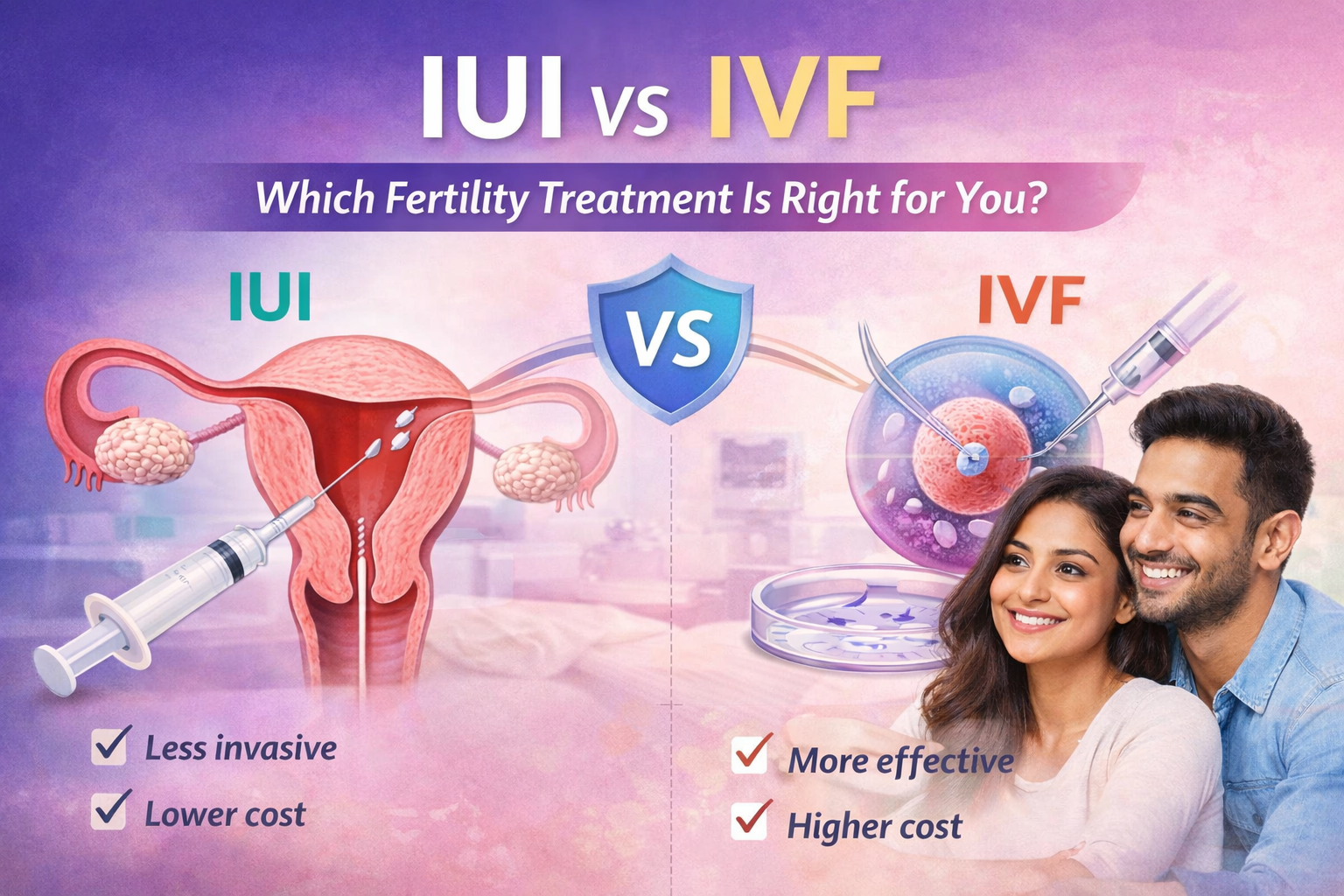
26 Feb IUI vs IVF: Which Fertility Treatment Is Right for You?
Table of Contents
One question comes up in almost every fertility consultation at Fertibless Clinic — “Should we start with IUI or go straight to IVF?”
It is one of the most important decisions a couple can make on their fertility journey, and it deserves a clear, honest answer. Both treatments can lead to a healthy pregnancy. But they work very differently, suit different diagnoses, and carry different expectations around cost, process, and success.
This guide by Dr. Shipra Gupta breaks down IUI vs IVF — so you can walk into your consultation informed, not overwhelmed.
The Core Difference Between IUI and IVF
The single most important distinction between the two treatments is where fertilization happens.
In IUI (Intrauterine Insemination), washed sperm is placed directly inside the uterus at the time of ovulation. Fertilization still happens naturally — inside the body — in the fallopian tube. IUI simply gives the sperm a head start by bypassing the cervix and reducing the distance it must travel.
In IVF (In Vitro Fertilization), eggs are retrieved from the ovaries through a minor procedure, fertilized with sperm in a laboratory, and the resulting embryo is transferred back into the uterus. Fertilization happens outside the body — under controlled, precise conditions.
Quick Answer: The key difference between IUI and IVF is where fertilization occurs. IUI supports fertilization inside the body; IVF creates embryos outside the body in a lab. This single difference shapes their success rates, costs, and who each treatment is best suited for.
Who Should Choose IUI?
IUI is typically recommended as a first-line treatment for couples with:
- Unexplained infertility
- Mild male factor infertility (slightly low sperm count or motility)
- Cervical mucus problems
- Irregular ovulation or PCOS
- Use of donor sperm
IUI is less invasive, less expensive, and emotionally lighter than IVF. For suitable candidates, it offers a genuine chance of conception — particularly in women under 35 — without the complexity of a full IVF cycle.
If you have been trying to conceive and are wondering whether it is time to seek medical help, our guide on when to see a fertility specialist is a helpful starting point. A complete fertility evaluation will confirm whether IUI is appropriate for your situation.
Who Should Choose IVF?
IVF is recommended when:
- Fallopian tubes are blocked or damaged — IVF bypasses the tubes entirely
- Severe male factor infertility — ICSI (injecting a single sperm directly into the egg) makes fertilization possible even with very low sperm counts
- IUI has failed after 3–4 well-timed cycles
- Advanced maternal age — IVF allows retrieval of multiple eggs and selection of the best embryo, maximizing limited time
- Endometriosis affecting reproductive organs
- Recurrent miscarriage — embryo genetic testing (PGT) is possible only with IVF
- Poor ovarian reserve — where quality embryo selection matters most
For couples over 38, or those with a clear diagnosis that IUI cannot address, moving directly to IVF may save valuable time.
IUI vs IVF: Success Rate Comparison
Success rates differ significantly between the two treatments, primarily due to the level of control each provides over the fertilization process.
| IUI | IVF | |
| Success Per Cycle (Under 35) | 10% – 20% | 40% – 50% |
| Success Per Cycle (35–40) | 8% – 15% | 30% – 40% |
| Success Per Cycle (Over 40) | 3% – 9% | 15% – 20% |
| Cumulative Success (3–4 cycles) | 30% – 40% | Higher per attempt |
IVF offers a significantly higher success rate per cycle because it gives the fertility team far greater control — from egg quality to embryo development and selection.
That said, IUI remains a clinically valid, evidence-based starting point for the right candidates. Our detailed blog on IVF success rates by age explains how age affects outcomes across both treatments.
Dr. Shipra Gupta, Fertibless Clinic: “Choosing between IUI and IVF is not about which treatment is ‘better’ — it is about which is most appropriate for your specific diagnosis, age, and reproductive history. A treatment that is perfect for one couple may not be right for another.”
IUI vs IVF: Cost Comparison
Cost is a real and valid consideration for every couple. In Delhi, approximate costs are:
| IUI | IVF | |
| Cost Per Cycle | ₹8,000 – ₹30,000 | ₹1,20,000 – ₹2,00,000+ |
| Medications | Minimal | Significant |
| Invasiveness | Low | Moderate |
| Lab Involvement | Sperm preparation only | Full embryology lab |
While IUI costs considerably less per cycle, multiple failed cycles can add up — both financially and emotionally. For some couples, particularly those over 38 or with a clear diagnosis, moving directly to IVF may prove more cost-effective in the long run.
For a transparent breakdown of all treatment costs, read our guide on the cost of fertility treatments in Delhi.
When Should You Move from IUI to IVF?
Most specialists, including Dr. Shipra Gupta, recommend transitioning to IVF if:
- 3–4 IUI cycles have not resulted in pregnancy
- Investigations reveal a condition that IUI cannot overcome (blocked tubes, severe sperm issues)
- Age is a concern — for women over 38, time is a critical factor
- Emotional fatigue from repeated unsuccessful IUI attempts is affecting quality of life
A failed IUI cycle is never just a setback — it provides important diagnostic information that helps refine the next step. Our blog on what to do when fertility treatments don’t work offers compassionate guidance for couples navigating this decision.
Conclusion
IUI and IVF are not competing treatments — they are complementary steps on a well-structured fertility pathway. For many couples, IUI is the right and logical starting point. For others, IVF offers the precision and success rates their situation demands.
The most important thing is not choosing between the two treatments in isolation — it is getting a thorough evaluation and a personalized plan from a specialist who understands your unique situation.
Your first consultation at Fertibless Clinic is exactly that starting point — a compassionate, expert conversation that puts you in control of your journey.
Consult Dr. Shipra Gupta at Fertibless Clinic, South Delhi
📞 +91 92899 36221 | 🌐 www.fertibless.com
Frequently Asked Questions
Is IUI or IVF more painful?
IUI is a quick, minimally uncomfortable in-office procedure requiring no sedation. IVF involves egg retrieval under light anesthesia, followed by a simple embryo transfer. Most patients tolerate both procedures well.
Can I try IUI before IVF even if I am 38?
Age is an important factor. While IUI may still be considered for women aged 35–38 with a good ovarian reserve, the lower success rate per cycle means fewer cycles are typically recommended before transitioning to IVF. Your doctor will advise based on your individual fertility profile.
Is the baby healthy after IVF compared to IUI?
Yes. Research consistently shows that children born through IUI and IVF are as healthy as those conceived naturally. You can learn more about IVF vs natural pregnancy in our dedicated blog.
What if both IUI and IVF fail?
There are still meaningful options — from donor eggs and embryos to modified protocols and further investigation. No single failure closes the door to parenthood.

Dr. Shipra Gupta is a renowned obstetrician, gynaecologist, and infertility specialist, boasting over 17 years of invaluable clinical, teaching, and research experience. She has successfully performed more than 1200 cycles of IUI, IVF, natural cycle IVF, donor egg, and FET cycles. Dr. Gupta specializes in managing complex cases involving Advanced Maternal Age, PCO, Poor Ovarian Reserve, endometriosis, and unexplained infertility. Her expertise extends to treating recurrent IVF failures and male infertility.