
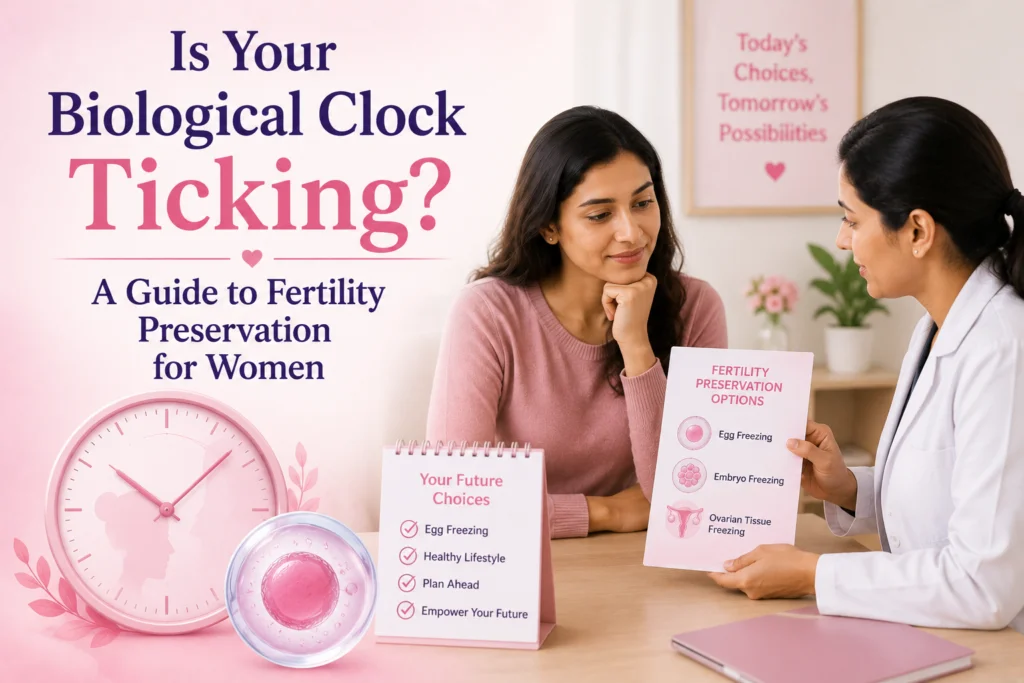
09 Jul Is Your Biological Clock Ticking? A Guide to Fertility Preservation for Women
Table of Contents
You are building your career. You are still figuring out your relationships. You are simply not ready yet. And somewhere in the back of your mind, a quiet voice whispers: will my eggs still be there when I am?
Fertility preservation for women is no longer a last resort — it is a proactive, informed choice that more women in Delhi and across India are making every year. This guide explains everything you need to know, honestly and clearly, so you can decide if it is right for you.
How Age Affects Your Fertility
Women are born with all the eggs they will ever have — approximately 1–2 million at birth. By puberty, this reduces to around 400,000. By the mid-30s, not only does the quantity decline but egg quality — the chromosomal integrity of each egg — also decreases.
Quick Answer: Fertility preservation for women typically involves egg freezing (oocyte cryopreservation) — a process in which a woman’s eggs are retrieved, vitrified (rapidly frozen), and stored for future use. The ideal age to freeze eggs is before 35, when egg quality and quantity are at their best. The frozen eggs can later be thawed, fertilised through IVF, and transferred as an embryo when the woman is ready to conceive.
This is why the decade between 25 and 35 represents a critical window for fertility planning — even if having a baby feels far away right now.
What Is Egg Freezing?
Egg freezing, also known as oocyte cryopreservation, is a technique in which mature eggs are extracted from the ovaries and preserved using vitrification — ultra-rapid freezing that prevents ice crystal formation and maintains egg integrity. Vitrification has transformed egg freezing from an experimental procedure to a well-established clinical option. Survival rates of frozen eggs after thawing now exceed 80–90% in most advanced fertility centres.
Who Should Consider Fertility Preservation?
Social (elective) reasons:
- Women who are not yet ready for pregnancy — career, education, relationships, or personal readiness
- Single women who want to keep their options open
- Women who have not yet found the right partner
Medical reasons:
- Women diagnosed with cancer about to undergo chemotherapy or radiation
- Women with endometriosis — a condition that progressively reduces ovarian reserve
- Women with a family history of early menopause
- Women with low AMH or diminishing ovarian reserve detected on routine testing
A simple blood test for AMH and an ultrasound to count antral follicles can give you a clear picture of your current ovarian reserve. Learn more about fertility tests for women on our website: fertibless.com/fertility-tests
The Egg Freezing Process — Step by Step
Step 1: Fertility Assessment — AMH test, antral follicle count, and a hormone panel to establish your ovarian reserve and design your stimulation protocol.
Step 2: Ovarian Stimulation (10–12 days) — Daily hormone injections to stimulate the ovaries to produce multiple mature eggs, monitored through blood tests and scans every 2–3 days.
Step 3: Egg Retrieval — A minor procedure under sedation — typically 15–20 minutes — in which mature eggs are collected using a fine needle guided by ultrasound.
Step 4: Vitrification and Storage — Mature eggs are rapidly frozen using vitrification and stored in liquid nitrogen. Eggs can remain in storage for many years without significant deterioration in quality.
Step 5: When You Are Ready — Thaw, Fertilise, Transfer — Your eggs are thawed, fertilised with sperm through IVF and ICSI, and transferred as an embryo in a Frozen Embryo Transfer (FET) cycle.
What Is the Best Age to Freeze Eggs?
Most fertility specialists recommend freezing before 35 — ideally between 30 and 34 — when egg quantity and quality are still strong. That said, each woman’s ovarian reserve is individual. Some women at 32 have lower reserves than others at 37. The only way to know where you stand is to get tested. An AMH test at Fertibless Clinic takes one blood draw and provides a clear snapshot of your current fertility status.
Embryo Freezing — The Couples Option
For couples who are together but not ready for pregnancy, embryo freezing — fertilising eggs with partner sperm before freezing — may offer higher success rates than egg freezing alone, as embryos are hardier than unfertilised eggs. Dr. Shipra Gupta can advise which option is more suitable based on your individual circumstances.
Expert Insight — Dr. Shipra Gupta, Fertibless Clinic
“Fertility preservation is one of the most empowering conversations I have with women. Many come in thinking it is too early to worry about fertility. But knowledge is never too early. Whether you choose to freeze your eggs or simply understand your reserve, that information puts you in control of your reproductive future.”
— Dr. Shipra Gupta, Reproductive Medicine Specialist, Fertibless Clinic, New Delhi
Frequently Asked Questions
At what age is it too late to freeze eggs?
Most fertility specialists recommend egg freezing before 38 for the best outcomes. While it can be done after 38, the number of viable eggs retrieved decreases with age. The earlier you freeze, the better the quality of the eggs preserved.
Does egg freezing affect future natural fertility?
No. The eggs retrieved for freezing come from the pool that would naturally be lost in that monthly cycle. Egg freezing does not deplete your remaining reserve or affect your ability to conceive naturally.
How many eggs do I need to freeze?
The number depends on your age. Generally, 10–15 mature eggs are considered a reasonable target for a woman under 35. Your specialist will tailor the stimulation protocol to aim for the best number based on your ovarian reserve.
Is egg freezing painful?
The stimulation injections cause minimal discomfort for most women. Egg retrieval is performed under sedation, so there is no pain during the procedure. Mild bloating and cramping afterwards typically resolve within 1–2 days.

Dr. Shipra Gupta is a renowned obstetrician, gynaecologist, and infertility specialist, boasting over 17 years of invaluable clinical, teaching, and research experience. She has successfully performed more than 1200 cycles of IUI, IVF, natural cycle IVF, donor egg, and FET cycles. Dr. Gupta specializes in managing complex cases involving Advanced Maternal Age, PCO, Poor Ovarian Reserve, endometriosis, and unexplained infertility. Her expertise extends to treating recurrent IVF failures and male infertility.