
26 Oct Fertility Blood Tests in Delhi: Which Hormone Tests You Need (AMH, FSH, TSH, Prolactin) and When to Get Them
If you have been trying to conceive without success, one of the first things a doctor will suggest is a set of blood tests. Hormones influence ovulation, egg reserve, sperm production and the health of an early pregnancy, so a few simple tests can give useful answers. The challenge is knowing which tests matter, what the numbers mean, and which day of the cycle to take them. This guide explains all three.
When Should You Get Fertility Tests Done?
Fertility testing is usually recommended when:
- You are under 35 and have been trying for 12 months without a pregnancy
- You are 35 or older and have been trying for 6 months
- You are over 40, in which case it is reasonable to start without waiting
- Your periods are irregular, very infrequent or absent
- You have known conditions such as PCOS, endometriosis, thyroid disease or a history of pelvic surgery
- You have had repeated miscarriages
- You are planning to freeze eggs, or considering treatment such as IUI or IVF
You do not need to wait for a problem to get an assessment. Testing early can also guide decisions about timing and options.
Fertility Blood Tests for Women
1. AMH (Anti-Müllerian Hormone)
What it shows: AMH is produced by the small follicles in your ovaries, so it gives an estimate of your ovarian reserve, meaning how many eggs you have left.
When to test: Any day of the cycle. It stays fairly stable, which makes it the most convenient hormone test.
How to read it:
- A low AMH suggests a reduced egg reserve and can mean a lower response to fertility medication.
- A high AMH is common in women with PCOS.
- Reference ranges differ between laboratories and with age, so interpret your result with a doctor.
Important: AMH reflects the number of eggs, not their quality. A low AMH does not mean you cannot conceive naturally, and a normal AMH does not guarantee a pregnancy.
2. FSH (Follicle-Stimulating Hormone)
What it shows: FSH is released by the pituitary gland to stimulate follicle growth. When the ovaries respond poorly, the body produces more FSH to compensate, so a high level can point to reduced ovarian reserve.
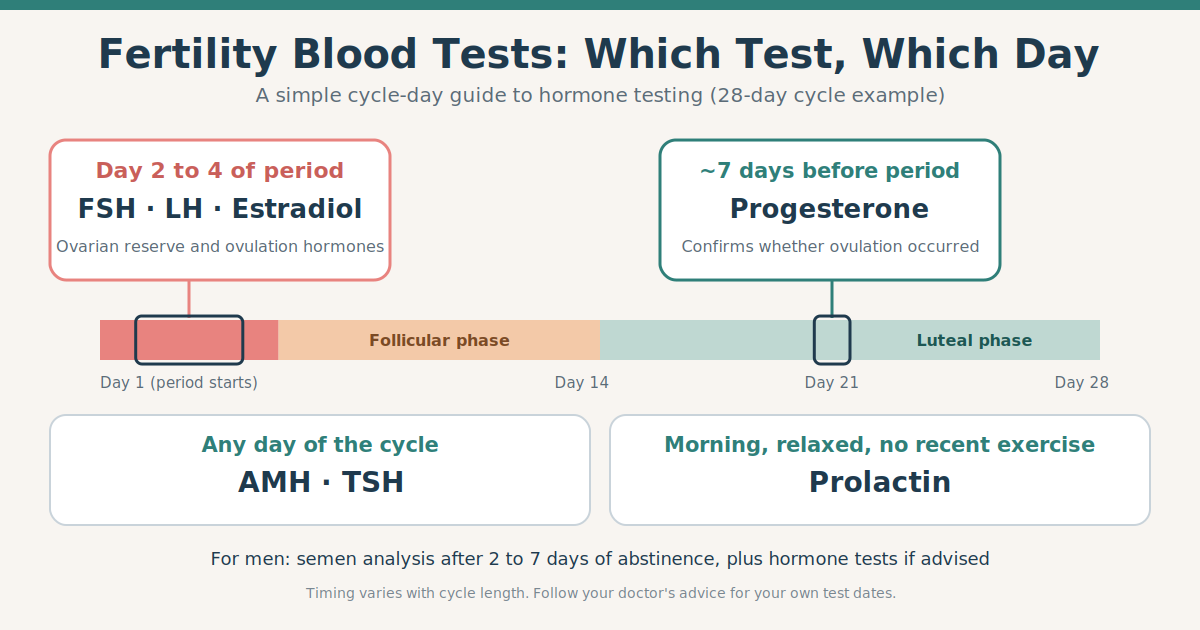
When to test: Usually on day 2 to 4 of your period, since levels change through the cycle.
How to read it: A persistently raised value suggests lower reserve, but FSH can vary from one cycle to the next, so one result is rarely used alone. It is best read alongside AMH, estradiol and an ultrasound.
3. LH (Luteinising Hormone)
What it shows: LH triggers ovulation. It is usually tested together with FSH.
How to read it: A high LH-to-FSH ratio can be a clue towards PCOS, though it does not diagnose it alone.
When to test: Day 2 to 4 with FSH. Home ovulation kits detect the LH surge separately.
4. Estradiol (E2)
What it shows: Estradiol is the main oestrogen. On day 2 to 4, an unusually high level can suppress FSH and make it look falsely normal, which is why doctors check both together.
When to test: Day 2 to 4, with FSH and LH.
5. TSH (Thyroid-Stimulating Hormone)
What it shows: The thyroid influences periods, ovulation and early pregnancy. Both an underactive and an overactive thyroid can affect fertility.
When to test: Any day of the cycle.
How to read it: Many fertility specialists prefer a TSH in the lower part of the normal range when planning a pregnancy. Thyroid problems are common and treatable, so an abnormal result is often a straightforward fix.
6. Prolactin
What it shows: Prolactin is best known for milk production, but when it is raised outside pregnancy and breastfeeding, it can stop ovulation and make periods irregular.
When to test: Ideally in the morning, after you have been awake for a short while, and not after intense exercise, a breast examination or a stressful moment. Stress alone can raise it.
How to read it: Mildly raised values are often repeated before acting. Causes include stress, certain medications, an underactive thyroid and, less often, a small benign pituitary growth. Treatment is usually simple once the cause is clear.
7. Progesterone (mid-luteal)
What it shows: Progesterone rises after ovulation, so a blood test confirms whether you actually ovulated.
When to test: About 7 days before your expected period, so around day 21 in a regular 28-day cycle. If your cycle is longer or irregular, the timing shifts, so ask your doctor to calculate it.
Other tests your doctor may add
- Testosterone, DHEAS and 17-OH progesterone, when PCOS or excess androgens are suspected
- Fasting glucose, insulin or HbA1c, as insulin resistance often goes with PCOS
- Vitamin D, haemoglobin and a blood count, as general health markers
- Rubella immunity and infection screening, before pregnancy or treatment
Fertility Tests for Men
Male factors contribute to roughly half of couples’ fertility difficulties, so testing both partners at the start saves time.
- Semen analysis is the key test. It measures sperm count, movement and shape. A usual recommendation is 2 to 7 days of abstinence before the sample.
- FSH, LH and testosterone help to find out whether low sperm production comes from a hormone problem or from the testes themselves.
- Prolactin and TSH are checked in selected cases.
If the semen analysis shows no sperm or very low numbers, further tests and procedures such as TESA or Micro-TESE may be discussed. Learn more about the specialist’s approach to male infertility.
Quick Guide: Which Test and When?
| Test | Best timing |
| AMH | Any day |
| FSH, LH, Estradiol | Day 2 to 4 of the period |
| TSH | Any day |
| Prolactin | Morning, relaxed, no recent exercise |
| Progesterone | About 7 days before the expected period |
| Semen analysis | After 2 to 7 days of abstinence |
Blood Tests Are Only Part of the Picture
Hormone results are rarely read in isolation. They are combined with:
- A pelvic ultrasound to count antral follicles and check the uterus and ovaries
- Your age, cycle pattern and medical history
- A semen analysis for your partner
- Tubal assessment, such as an HSG, when needed
For example, AMH is more meaningful when matched with the antral follicle count on the scan.
What Happens After Abnormal Results?
An abnormal result does not mean treatment is hopeless. The next step depends on the finding:
- Thyroid or prolactin problems are usually corrected with medication, after which ovulation often returns to normal.
- Ovulation problems may be treated with ovulation induction.
- Low ovarian reserve may change how quickly you act, and some women consider egg freezing while eggs are still available.
- Combined or unexplained factors may lead to a discussion about IUI or IVF.
Preparing for Your Blood Test
- Tell the lab or doctor which day of your cycle it is
- Follow any fasting instructions for glucose or insulin tests
- Mention all medications and supplements, including hormonal pills, thyroid medicine and biotin, which can interfere with some lab results
- Use the same lab for repeat tests when possible, since reference ranges differ between labs
Frequently Asked Questions
Which blood test is the most important for fertility?
There is no single test. AMH, FSH, TSH and prolactin each answer different questions, and a doctor chooses based on your history. For men, semen analysis is the first test.
Can I do the AMH test on any day?
Yes. AMH stays fairly stable across the cycle, unlike FSH, LH and estradiol.
Do I need to fast for fertility blood tests?
Most hormone tests do not need fasting. Glucose and insulin tests do. Your doctor or lab will tell you.
Can a low AMH mean I cannot get pregnant?
No. It indicates a lower egg count, not that pregnancy is impossible, especially if you are young. It is a reason to plan with a specialist rather than a final answer.
How long do results take?
Most hormone results are ready within a day or two, though this depends on the lab.
Can stress affect hormone results?
Yes, prolactin in particular can rise with stress, which is why abnormal values are often rechecked.
Should both partners be tested?
Yes. Testing both at the same time avoids delays, since male factors contribute to a large share of cases.
When to Speak to a Fertility Specialist
If your results are abnormal, or you have been trying for the time frames listed above, a specialist can interpret the full picture and suggest the next step. Learn more about fertility blood tests at Fertibless, meet Dr. Shipra Gupta, or visit the Fertibless homepage for an overview of fertility care in Delhi.
Medical disclaimer: This article is for information only and is not a substitute for personal medical advice. Reference ranges vary between laboratories. Please consult a qualified fertility specialist to interpret your results.

Dr. Shipra Gupta is a renowned obstetrician, gynaecologist, and infertility specialist, boasting over 17 years of invaluable clinical, teaching, and research experience. She has successfully performed more than 1200 cycles of IUI, IVF, natural cycle IVF, donor egg, and FET cycles. Dr. Gupta specializes in managing complex cases involving Advanced Maternal Age, PCO, Poor Ovarian Reserve, endometriosis, and unexplained infertility. Her expertise extends to treating recurrent IVF failures and male infertility.