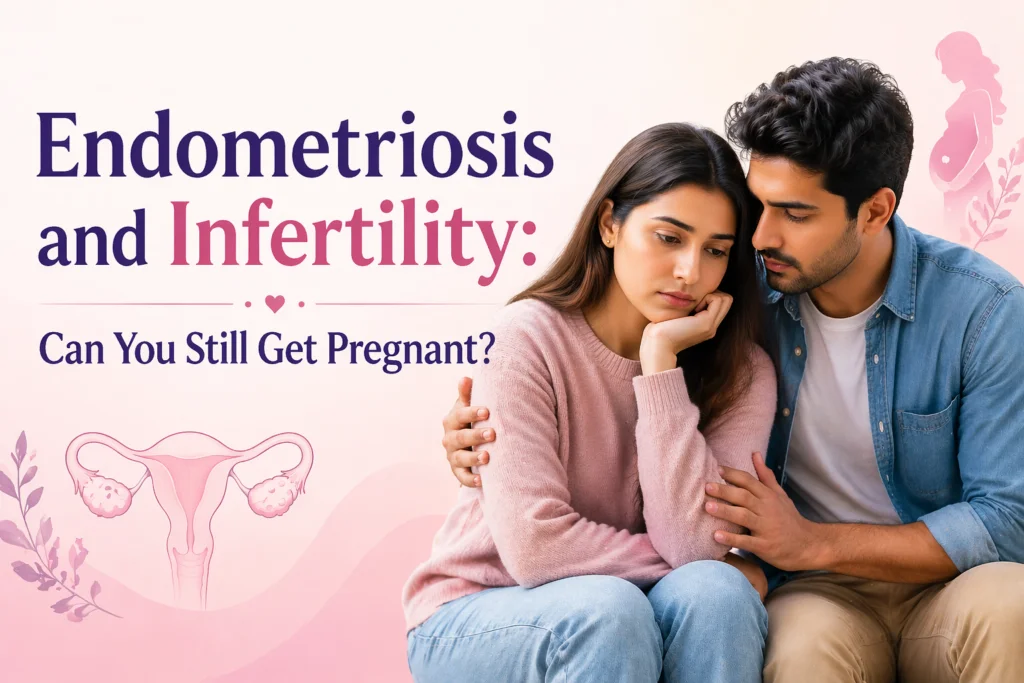
04 Apr Endometriosis and Infertility: Can You Still Get Pregnant?
Table of Contents
Endometriosis and infertility are two words no woman wants to hear together — yet for millions of women, this combination is their reality. If you have been diagnosed with endometriosis and infertility is now a concern, the most important thing to understand is this: pregnancy is still possible for most women with the right specialist care.
At Fertibless Clinic in Delhi, Dr. Shipra Gupta specialises in managing endometriosis-related fertility challenges, offering compassionate, evidence-based guidance to women at every stage of their journey.
What Is Endometriosis and How Does It Lead to Infertility?
Endometriosis is a chronic condition in which tissue similar to the uterine lining (endometrium) grows outside the uterus on the ovaries, fallopian tubes, pelvic lining, and in some cases other organs. This tissue responds to monthly hormonal changes, swelling and bleeding just like the endometrium but with nowhere to exit, it causes inflammation, scar tissue, and adhesions.
It affects approximately 1 in 10 women of reproductive age, yet it takes an average of 6–10 years from symptom onset to diagnosis often because symptoms are normalised or dismissed. This is the core mechanism that links endometriosis and infertility — and understanding it helps couples make sense of their diagnosis and treatment options.
How Endometriosis and Infertility Are Connected
The relationship between endometriosis and infertility is not straightforward — it varies significantly by stage, location, and the individual woman’s biology.:
- Distorted anatomy — Adhesions and scar tissue can block or distort the fallopian tubes, preventing the egg from reaching the uterus.
- Ovarian damage — Endometriomas (chocolate cysts) on the ovaries can damage healthy ovarian tissue and reduce egg reserve.
- Inflammation — The chronic inflammatory environment in the pelvis may impair egg quality, fertilisation, and implantation.
- Hormonal disruption — Endometriosis can interfere with ovulation and the hormonal signalling required for conception.
- Immune abnormalities — Altered immune response may prevent a fertilised embryo from implanting successfully.
That said, up to 70% of women with minimal to mild endometriosis (Stage I or II) will conceive naturally with time. The impact on fertility depends heavily on the stage and location of the disease.
Understanding the Four Stages
Endometriosis is classified into four stages by the American Society for Reproductive Medicine (ASRM):
- Stage I (Minimal) — Small, isolated patches of endometrial tissue; minimal adhesions.
- Stage II (Mild) — More widespread lesions, mild adhesions around the ovaries or fallopian tubes.
- Stage III (Moderate) — Multiple implants, endometriomas present, more significant adhesions.
- Stage IV (Severe) — Extensive disease with large cysts, dense adhesions, distorted pelvic anatomy.
Understanding the stage of disease is essential for determining the right endometriosis and infertility treatment pathway. Higher stages generally correlate with greater challenges to fertility — but even women with Stage IV endometriosis have achieved successful pregnancies.
Recognising the Signs
- Painful periods (dysmenorrhea) — Pain that is severe, progressive, or requires medication to manage.
- Pelvic pain — Chronic or cyclical pain between periods.
- Pain during intercourse (dyspareunia) — Particularly with deep penetration.
- Pain with bowel movements or urination — Often worse during menstruation.
- Heavy or irregular periods.
- Difficulty conceiving despite regular unprotected intercourse.
Not all women with endometriosis experience symptoms — some are only diagnosed when investigating infertility.
How Endometriosis Is Diagnosed
Diagnosis typically involves:
- Transvaginal ultrasound — Can detect endometriomas but may miss smaller implants.
- MRI — Useful for mapping severe disease or deep infiltrating endometriosis.
- Laparoscopy — The gold standard for diagnosis and staging. A minimally invasive surgery allows direct visualisation and biopsy of lesions.
Treatment Pathways for Fertility
Surgical Treatment
Laparoscopic surgery to remove endometrial implants, clear adhesions, and drain or remove endometriomas may improve the pelvic environment for natural conception or IVF. However, surgery on ovarian cysts carries the risk of reducing ovarian reserve — a careful decision requiring specialist judgment.
IUI (Intrauterine Insemination)
For women with mild endometriosis and open fallopian tubes, IUI — often combined with ovarian stimulation — may be a first-line assisted reproductive option.
IVF (In Vitro Fertilisation)
IVF bypasses the fallopian tubes entirely and allows fertilisation to occur in a controlled environment. For women with moderate to severe endometriosis, or for those where other treatments have not succeeded, IVF offers the highest success rates. Careful stimulation protocols are used to avoid ovarian hyperstimulation in the context of endometriomas. IVF remains the most effective assisted reproductive option for managing endometriosis and infertility together, particularly when anatomy is distorted or reserve is compromised.
Medical Suppression Before IVF
In some cases, 3–6 months of hormonal suppression (such as GnRH agonists) before IVF may reduce disease activity and improve the endometrial environment for implantation. This approach varies by case.
| Expert Insight — Dr. Shipra Gupta Endometriosis and infertility require a highly individualised approach. I always evaluate the full picture — the stage of disease, the patient’s age, ovarian reserve, and how long they have been trying. Sometimes a minimally invasive surgical approach opens a path to natural conception; in other cases, moving directly to IVF is the right decision. What matters is that no time is wasted on a strategy unlikely to work for that particular woman. — Dr. Shipra Gupta, Infertility Specialist, Fertibless Clinic, Delhi |
Lifestyle Choices That May Help
- Anti-inflammatory diet — Foods rich in omega-3s, leafy greens, and antioxidants may help reduce systemic inflammation.
- Limit red meat and trans fats — Associated with higher endometriosis risk and progression.
- Regular moderate exercise — Shown to reduce pain and may support hormonal balance.
- Avoid alcohol and tobacco — Both can worsen inflammatory conditions.
When to Seek Help
If you have been trying to conceive for 6 months or more and have symptoms suggestive of endometriosis, do not wait to seek a specialist evaluation. Endometriosis and infertility require early intervention — the sooner the diagnosis is confirmed, the more treatment options remain available. For women over 35 with suspected endometriosis, evaluation should begin immediately. Early intervention protects your ovarian reserve and expands your treatment options.
Reference: American Society for Reproductive Medicine (ASRM) — www.asrm.org | World Health Organization — www.who.int
Frequently Asked Questions
Can I conceive naturally with endometriosis?
Yes — especially with minimal or mild disease. Many women with Stage I or II endometriosis conceive naturally. However, conception may take longer, and fertility evaluation is recommended if you have been trying without success for 6–12 months. For couples navigating endometriosis and infertility together, earlier evaluation is always better than waiting.
Will removing an endometrioma improve my fertility?
It depends on the size, location, and your overall ovarian reserve. Surgery may improve the pelvic environment and access during egg collection, but it also carries a risk of reducing ovarian reserve. Your specialist will weigh the benefits and risks carefully for your specific case.
Does endometriosis come back after surgery?
Yes, endometriosis has a known recurrence rate. Surgery reduces disease burden but does not eliminate it permanently. This is one reason why fertility specialists often recommend proceeding with IVF promptly after surgery rather than waiting.
Can I do IVF with an endometrioma still present?
In many cases, yes — though your specialist may recommend draining or removing the cyst first if it is large (typically >4 cm) or interferes with egg collection. Each case is evaluated individually.
Does endometriosis affect IVF success rates?
Studies suggest that endometriosis may slightly reduce egg quality and embryo implantation rates compared to women without the condition. However, many women with endometriosis achieve successful IVF pregnancies, particularly with specialist-tailored protocols.
Is endometriosis hereditary?
There is a genetic component — women with a first-degree relative with endometriosis have a higher risk of developing the condition. However, not all daughters or sisters of women with endometriosis will develop it.

Dr. Shipra Gupta is a renowned obstetrician, gynaecologist, and infertility specialist, boasting over 17 years of invaluable clinical, teaching, and research experience. She has successfully performed more than 1200 cycles of IUI, IVF, natural cycle IVF, donor egg, and FET cycles. Dr. Gupta specializes in managing complex cases involving Advanced Maternal Age, PCO, Poor Ovarian Reserve, endometriosis, and unexplained infertility. Her expertise extends to treating recurrent IVF failures and male infertility.