
13 May Adenomyosis and Fertility: Can You Still Get Pregnant?
Table of Contents
Adenomyosis and fertility are two terms that more women are encountering — yet adenomyosis remains one of the most underdiagnosed conditions in reproductive medicine. If you have been experiencing painful, heavy periods, difficulty conceiving, or recurrent pregnancy loss without a clear explanation, adenomyosis and fertility may be at the heart of the problem.
This article explains what adenomyosis is, exactly how it affects fertility and IVF outcomes, how it is diagnosed, and what treatment options exist for women who want to conceive — including those at Fertibless Clinic in Delhi.
What Is Adenomyosis?
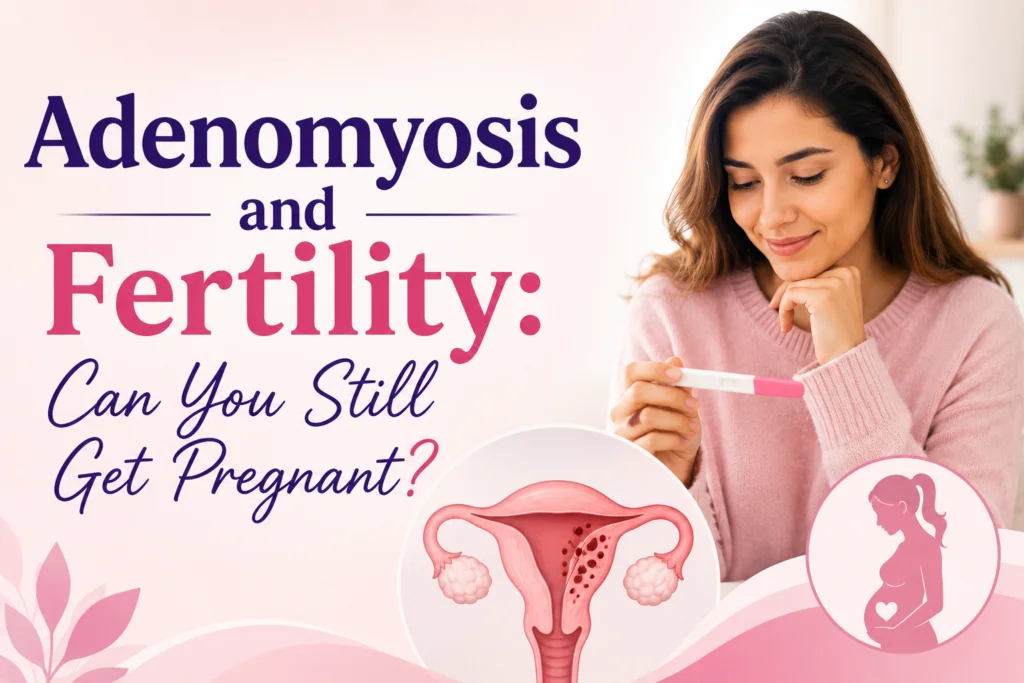
Adenomyosis is a condition in which the tissue that normally lines the uterine cavity (the endometrium) grows into the muscular wall of the uterus (the myometrium). Unlike endometriosis — where tissue grows outside the uterus — adenomyosis is entirely within the uterine wall. However, the two conditions frequently co-exist, and both impact adenomyosis and fertility outcomes.
Our companion article on endometriosis and infertility explains the related but distinct condition of endometriosis — and how it similarly affects implantation and conception.
Adenomyosis can be focal (affecting a specific area of the uterus) or diffuse (affecting the entire uterine wall). The condition is thought to affect 10–35% of women of reproductive age — but because its symptoms overlap with other conditions, it is frequently missed or misdiagnosed for years.
How Adenomyosis Affects Fertility
The adenomyosis and fertility relationship operates through several biological mechanisms that impair conception and early pregnancy:
- Distorted uterine cavity — The invasion of endometrial tissue into the myometrium changes the shape and contractility of the uterus, creating an unfavourable environment for embryo implantation.
- Impaired endometrial receptivity — Adenomyosis disrupts the gene expression of the endometrium during the implantation window, reducing its capacity to accept and support a fertilised embryo.
- Abnormal uterine contractions — Adenomyosis causes irregular, often forceful uterine contractions — particularly around the time of embryo transfer — which may physically prevent implantation.
- Inflammation — Chronic inflammatory mediators produced within the adenomyotic myometrium affect both egg quality and the endometrial environment.
- Impaired blood flow — Adenomyosis alters uterine blood flow patterns, reducing the perfusion to the endometrium needed for embryo nidation.
The cumulative effect of these mechanisms is that adenomyosis and fertility outcomes are significantly linked — women with adenomyosis have lower clinical pregnancy rates, lower implantation rates in IVF, and higher rates of miscarriage and recurrent pregnancy loss compared to women without the condition.
If you have experienced repeated losses, our article on recurrent pregnancy loss explores all causes — including uterine structural factors like adenomyosis — in detail.
Recognising Adenomyosis — Symptoms to Know
- Heavy, prolonged menstrual bleeding (menorrhagia) — often progressively worsening over years.
- Severe period pain (dysmenorrhea) — particularly cramps that radiate to the lower back or thighs.
- Bloating and a sensation of pelvic fullness — caused by the enlarged, boggy uterus characteristic of diffuse adenomyosis.
- Pain during intercourse (dyspareunia).
- Difficulty conceiving despite regular unprotected intercourse.
- Recurrent early pregnancy loss.
Importantly, some women with adenomyosis and fertility challenges have minimal symptoms — adenomyosis is sometimes only discovered during investigation for infertility.
How Adenomyosis Is Diagnosed
Adenomyosis and fertility evaluation begins with a detailed clinical history and pelvic examination. Diagnosis is confirmed through:
- Transvaginal ultrasound (TVUS) — The first-line imaging tool. Features suggesting adenomyosis include an enlarged uterus, asymmetric myometrial thickening, and heterogeneous myometrial echotexture. At Fertibless Clinic, our fertility ultrasound assessment evaluates all these features carefully.
- MRI — The most accurate imaging tool for adenomyosis, capable of classifying the extent and distribution of disease and differentiating between focal and diffuse types.
- Hysteroscopy — Direct visualisation of the uterine cavity through a hysteroscopy procedure can identify surface changes associated with adenomyosis. Read our full guide on hysteroscopy for fertility to understand what this procedure involves.
- Histology — Definitive diagnosis requires examination of myometrial tissue, which can be obtained from a surgical biopsy. Hysterectomy specimens remain the gold standard, though this is not applicable to women seeking fertility treatment.
Adenomyosis and Fertility Treatment Options
Medical Suppression Before IVF
For women with adenomyosis and fertility treatment plans involving IVF, a period of medical suppression using GnRH agonists (typically 3–6 months before egg retrieval or frozen embryo transfer) may improve the uterine environment by shrinking adenomyotic tissue and reducing inflammation. Evidence supports improved IVF outcomes following pre-treatment suppression in women with moderate to severe adenomyosis.
IVF with Frozen Embryo Transfer
Many specialists recommend a freeze-all strategy for women with adenomyosis and fertility concerns — meaning all embryos are frozen after retrieval, and transfer is performed in a separate, medicated frozen embryo transfer cycle. This allows the uterus to recover from stimulation and any inflammatory activity before transfer, potentially improving implantation rates.
Surgical Treatment
For focal adenomyosis — where a specific adenomyoma (a localised mass of adenomyotic tissue) is identified — surgical excision may improve the uterine environment for conception. This approach requires highly skilled surgical judgment, as excessive removal of myometrial tissue can weaken the uterine wall.
| Expert Insight — Dr. Shipra Gupta Adenomyosis and fertility is a combination that requires very careful, individualised management. I always start by staging the extent of the disease on MRI and ultrasound, then discussing the realistic impact on IVF outcomes with the couple. For many women, a period of GnRH agonist suppression before IVF followed by a frozen transfer in a prepared cycle gives the best results. The key is never to rush the transfer into a uterus that is still inflamed from adenomyosis — preparation is everything. — Dr. Shipra Gupta, Infertility Specialist, Fertibless Clinic, Delhi |
Reference: ASRM — www.asrm.org | ESHRE Endometriosis & Adenomyosis Guidelines — www.eshre.eu | RCOG — www.rcog.org.uk | NIH — PubMed
Frequently Asked Questions
Can I get pregnant naturally with adenomyosis?
Yes — particularly with mild or focal adenomyosis. Many women with adenomyosis and fertility concerns do conceive naturally, though it may take longer and miscarriage risk may be elevated. For women with moderate to severe adenomyosis, or those over 35, seeking specialist evaluation sooner rather than later is strongly recommended.
Does adenomyosis always cause infertility?
No. Adenomyosis and fertility are not mutually exclusive. The impact depends on the type (focal vs diffuse), the extent of disease, and the individual’s age and ovarian reserve. Mild focal adenomyosis may have minimal impact on fertility, while diffuse adenomyosis can significantly reduce implantation rates and increase miscarriage risk.
Can adenomyosis be cured?
The definitive treatment for adenomyosis is hysterectomy — which is not an option for women wishing to conceive. Medical and surgical treatments reduce disease burden and improve the uterine environment but do not eliminate adenomyosis permanently. Disease may recur after suppression ends or following conservative surgery.
Does adenomyosis worsen over time?
Yes, adenomyosis tends to be a progressive condition, particularly in the reproductive years. This is one reason why women with adenomyosis and fertility goals are advised not to delay fertility evaluation and treatment — the uterine environment may deteriorate with time.
How does adenomyosis affect IVF success rates?
Studies show that adenomyosis reduces clinical pregnancy rates and live birth rates in IVF by approximately 20–30% compared to women without the condition. However, with appropriate pre-treatment (GnRH suppression) and a freeze-all/FET strategy, outcomes can be meaningfully improved. Discussing your specific case with Dr. Shipra Gupta is essential.
| Dealing with adenomyosis and fertility challenges? Consult Dr. Shipra Gupta at Fertibless Clinic, Delhi for expert evaluation and a treatment plan tailored to your case. |

Dr. Shipra Gupta is a renowned obstetrician, gynaecologist, and infertility specialist, boasting over 17 years of invaluable clinical, teaching, and research experience. She has successfully performed more than 1200 cycles of IUI, IVF, natural cycle IVF, donor egg, and FET cycles. Dr. Gupta specializes in managing complex cases involving Advanced Maternal Age, PCO, Poor Ovarian Reserve, endometriosis, and unexplained infertility. Her expertise extends to treating recurrent IVF failures and male infertility.