
19 Oct Egg Freezing in Delhi: Ideal Age, Success Rates, Process and Cost Explained
More women in Delhi are choosing to freeze their eggs, whether to focus on a career, wait for the right partner, or protect fertility before medical treatment. Egg freezing can widen your options, but it is not a guarantee of a future pregnancy. This guide covers what it involves, what the evidence says about age and success, and what to expect from the process and the cost.
What Is Egg Freezing?
Egg freezing, also called oocyte cryopreservation, is a procedure in which a woman’s eggs are collected, frozen and stored for later use. When she is ready, the eggs are thawed, fertilised in the laboratory and transferred to the uterus as embryos through in vitro fertilization (IVF).
Modern clinics use a rapid-freezing technique called vitrification. It prevents damaging ice crystals from forming inside the egg, and it has largely replaced older slow-freezing methods because eggs survive thawing much better.
Who Should Consider Egg Freezing?
Egg freezing may be worth discussing if you:
- Want to delay pregnancy for personal, educational or professional reasons
- Have no partner yet but want to keep future options open
- Are about to start treatment that can affect fertility, such as chemotherapy or pelvic radiotherapy
- Have a condition that may reduce ovarian reserve over time, such as endometriosis or ovarian surgery history
- Have a family history of early menopause
- Have had a blood test or scan suggesting a lower egg reserve than expected for your age
Egg freezing is also not for everyone. If you are already in your late 30s or 40s, a fertility specialist may suggest other routes, depending on your tests.
What Is the Ideal Age to Freeze Eggs?
Egg quantity and quality both decline with age, and quality is the bigger factor. A younger egg is more likely to be chromosomally normal, which affects fertilisation, embryo development and pregnancy.
- Under 35: Generally the most favourable window. Women in their late 20s and early 30s tend to retrieve more eggs per cycle and need fewer cycles.
- 35 to 37: Still a reasonable time to freeze, but you may need more eggs, sometimes from more than one cycle, to reach the same chance of success.
- 38 and above: Freezing is still possible, but fewer eggs are usually retrieved and each egg has a lower chance of leading to a baby. A detailed assessment matters more here.
The age at which you freeze your eggs matters more than the age at which you use them. Eggs frozen at 30 behave like 30-year-old eggs when thawed.
How Many Eggs Should You Freeze?
There is no single number, but research gives a useful guide. Studies suggest that for women under 35, around 10 to 15 mature frozen eggs give a good chance of at least one live birth. Women in their late 30s generally need more. Because not every egg survives thawing, fertilises or becomes a healthy embryo, more eggs improve the odds. Your AMH level and antral follicle count help estimate how many eggs a cycle might yield.
Egg Freezing Success Rates
Success depends mainly on your age at freezing, the number of mature eggs stored, and the quality of the clinic’s embryology laboratory. These are the typical stages:
- Survival after thawing: With vitrification, most eggs survive, commonly above 90% in good laboratories.
- Fertilisation: A good share of surviving eggs fertilise, usually through ICSI, where a single sperm is injected into each egg.
- Live birth per egg: This is modest. Even in younger women, only a small fraction of individual frozen eggs ends in a live birth, which is why the number of eggs matters so much.
Be careful with any clinic that quotes a single high success rate for egg freezing. Ask for results broken down by age group and whether the figures refer to eggs frozen, embryos transferred or live births.
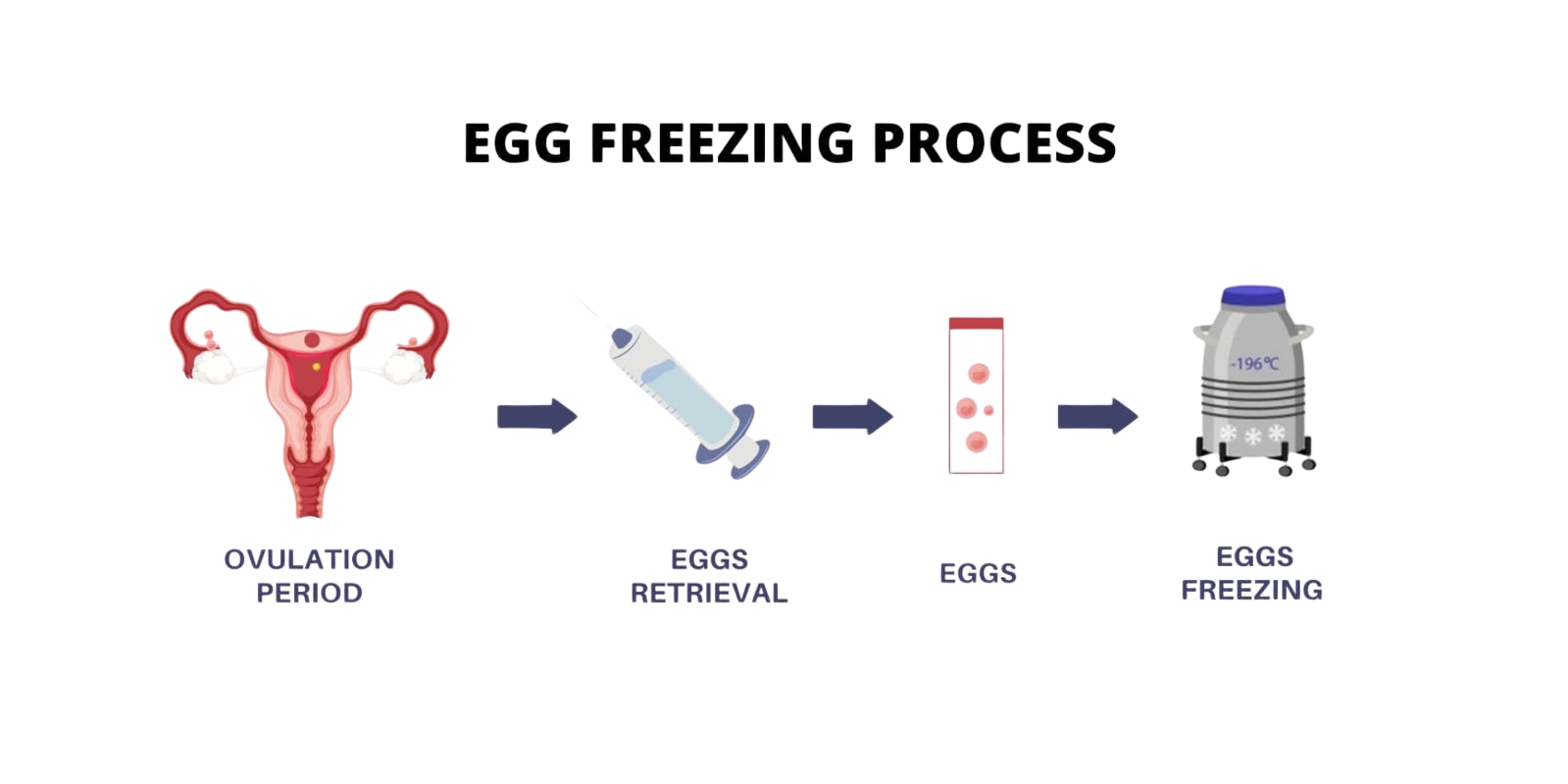
The Egg Freezing Process Step by Step
1. Initial consultation and tests
Your doctor reviews your medical history and orders tests. These usually include an AMH and hormone blood test and a pelvic ultrasound to count antral follicles. Screening for infections is also standard.
2. Ovarian stimulation (about 8 to 14 days)
You take daily hormone injections so that several eggs mature in the same cycle instead of just one. The process is similar to the stimulation used in ovulation induction, though the aim is to produce more eggs. You have regular scans and sometimes blood tests so the dose can be adjusted.
3. Trigger injection
When the follicles reach the right size, a final injection prepares the eggs for retrieval, which is timed about 34 to 36 hours later.
4. Egg retrieval
This is a short procedure under light sedation, usually 15 to 30 minutes. A fine needle guided by ultrasound collects the eggs through the vaginal wall, so no incisions are needed. Most women go home the same day and resume normal activity within a day or two.
5. Freezing and storage
Mature eggs are vitrified the same day and stored in liquid nitrogen. Immature eggs cannot usually be frozen, so the number you store may be lower than the number retrieved.
6. Using the eggs later
When you decide to try for a pregnancy, the eggs are thawed, fertilised and transferred as embryos. This stage is billed separately from freezing.
Risks and Side Effects
Egg freezing is generally safe, but it is a medical procedure. Possible effects include:
- Bloating, mild pelvic discomfort and mood changes during stimulation
- Ovarian hyperstimulation syndrome (OHSS), a rare overreaction to the hormones. Doctors reduce the risk by adjusting doses and using suitable protocols.
- Small risks from sedation, bleeding or infection after retrieval, which are uncommon
- Emotional stress. It is normal to feel anxious about the process or the uncertainty of the outcome.
Ask your doctor which protocol they plan to use and how they will monitor you.
Egg Freezing Cost in Delhi: What Affects the Price
The total depends on the clinic and your individual needs, so it is better to understand the components than to compare headline numbers. In India, the cost of egg freezing typically ranges from ₹1.5 lakh to ₹4 lakh per cycle, and Annual storage fees will vary around ₹20,000 to ₹50,000.
Several factors affect the final cost:
- Pre-treatment tests: blood tests, ultrasound and screening
- Medication: the dose depends on your age and ovarian reserve, and women with a lower reserve often need more
- Retrieval and anaesthesia: procedure, sedation and day-care charges
- Freezing: laboratory vitrification charges, sometimes per egg or per batch
- Storage: typically an annual fee, which adds up over the years
- Repeat cycles: some women need more than one cycle to store enough eggs
- Future use: thawing, fertilisation (ICSI) and embryo transfer are separate from the freezing package
Questions to ask any clinic before you start
- Is the quote all-inclusive, or are medication and storage extra?
- Does it include the first year of storage, and what are the renewal fees?
- What happens if too few eggs are retrieved in a cycle?
- What are the clinic’s thaw survival and pregnancy rates by age?
- Is the clinic registered under India’s Assisted Reproductive Technology (Regulation) Act?
- What are the current limits on how long eggs can be stored?
Frequently Asked Questions
Is egg freezing painful?
The injections can cause mild discomfort and bloating. The retrieval is done under sedation, so you should not feel it. Some cramping afterwards is common and usually passes in a day or two.
Does egg freezing affect future fertility?
Current evidence suggests it does not reduce your natural fertility. Only the eggs that would otherwise have been lost in that cycle are collected.
How long can eggs be stored?
Eggs can remain viable for many years when stored properly, but storage periods are governed by regulations and your consent. Confirm the current rules with your clinic.
Does egg freezing guarantee a baby?
No. It improves your chances compared with waiting without any preparation, but it does not guarantee a pregnancy.
Can I freeze eggs if my AMH is low?
Yes, it is still possible, but the number retrieved may be low, and your doctor may suggest more than one cycle or a different approach.
How soon can I get back to work?
Most women rest for a day after retrieval and return to routine activities within one to two days.
Is Egg Freezing Right for You?
The best way to decide is with your own data. A fertility specialist can check your ovarian reserve, explain what a realistic outcome looks like for your age, and help you plan. Early information helps whichever route you eventually choose.
If you want to discuss your own situation, you can book a consultation with Dr. Shipra Gupta or learn more about egg freezing at Fertibless. For other services, visit the Fertibless homepage.
Medical disclaimer: This article is for information only and is not a substitute for personal medical advice. Please consult a qualified fertility specialist about your own situation.

Dr. Shipra Gupta is a renowned obstetrician, gynaecologist, and infertility specialist, boasting over 17 years of invaluable clinical, teaching, and research experience. She has successfully performed more than 1200 cycles of IUI, IVF, natural cycle IVF, donor egg, and FET cycles. Dr. Gupta specializes in managing complex cases involving Advanced Maternal Age, PCO, Poor Ovarian Reserve, endometriosis, and unexplained infertility. Her expertise extends to treating recurrent IVF failures and male infertility.