
21 Sep Egg Freezing at 30 vs 35 vs 40: What the Success Rates Actually Depend On
Egg freezing is often searched as a single question — “how much does egg freezing cost” or “is egg freezing worth it” — as if age is a footnote. It isn’t. Age at the time of freezing is the single biggest factor in whether frozen eggs go on to produce a baby, more influential than the clinic, the lab technology, or almost anything else in the process.
This article explains why that is, what actually changes in the ovaries between 30, 35 and 40, and what the numbers mean for someone trying to decide when — or whether — to freeze.
The one distinction that matters most
There are two ages involved in egg freezing, and they are not equally important.
Age at freezing determines the quality of the eggs collected. This is fixed the moment the eggs are retrieved and does not change afterwards, no matter how long they stay frozen.
Age at thaw — when the eggs are eventually used — matters much less than people assume, because the uterus of a woman in her forties can generally carry a pregnancy from a good-quality embryo just as well as it could a decade earlier. The eggs themselves are what age; the uterus, comparatively, does not.
This is the reason the entire conversation around egg freezing centres on one question: how old were you when the eggs were frozen?
Freezing eggs does not mean giving up on natural conception
A common misunderstanding is that once eggs are frozen, the only path to pregnancy afterwards is IVF. That isn’t how it works.
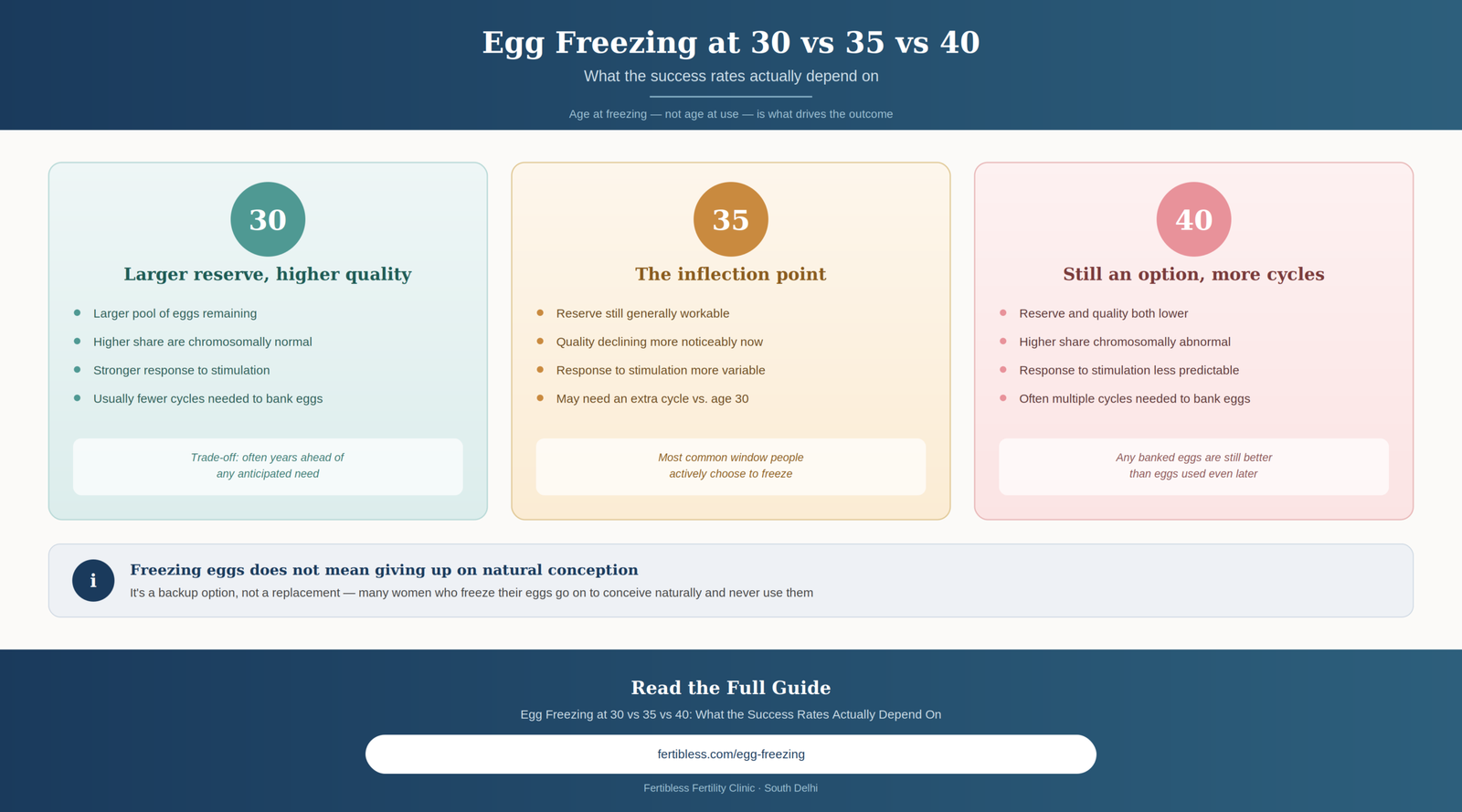
Freezing eggs simply banks a set of eggs at their current quality, as a safeguard for later. It doesn’t change anything about a woman’s ability to try to conceive naturally in the years that follow. Many women who freeze their eggs go on to conceive on their own — sometimes years later — and never end up using the frozen eggs at all.
The frozen eggs exist as a backup option, not a replacement for natural conception. They typically come into consideration only if pregnancy hasn’t happened naturally by the time the woman is ready to try, or if a fertility issue arises later that makes natural conception harder. Egg freezing is best thought of as preserving a choice, not committing to a particular route to pregnancy.
What’s actually changing in the ovaries with age
Every woman is born with all the eggs she will ever have — roughly one to two million at birth, already declining before puberty even begins. By the time periods start, that number has fallen to around 300,000–400,000. From there, the decline continues steadily every month, whether or not a pregnancy is being attempted.
Two things decline in parallel, and they are not the same thing:
Egg quantity — how many eggs remain, reflected in blood tests like AMH and antral follicle count on ultrasound. Quantity falls gradually through the twenties, more noticeably from the mid-thirties, and sharply after 40.
Egg quality — the proportion of eggs that are chromosomally normal. This is the harder decline to see coming, because it doesn’t show up on a standard fertility blood panel. A woman can have an entirely normal AMH for her age and still have a meaningfully higher proportion of chromosomally abnormal eggs than she did five years earlier. Quality is what actually drives whether a fertilised egg develops into a healthy embryo, and it declines well before quantity becomes a visible problem.
Egg freezing addresses quality directly, by capturing eggs before this decline progresses further — it does nothing to address quantity, which is why the number of eggs frozen also depends heavily on age.
Freezing at 30
What the ovaries typically offer: A larger pool of eggs remains, and a higher proportion of them are chromosomally normal compared to later years. Ovarian stimulation for retrieval also tends to produce a stronger response — more mature eggs per cycle — because reserve is generally still robust at this age.
What this means practically: Fewer stimulation cycles are usually needed to bank a reasonable number of eggs, because more eggs are typically retrieved per cycle and a higher share are usable.
The trade-off: Thirty is, for most women, well before fertility becomes an active concern, and freezing at this stage means paying for a service years ahead of any anticipated need — and possibly never using it at all. The eggs retrieved are of the best quality this process is likely to yield, but that value is realised only if the eggs are eventually used.
Freezing at 35
Thirty-five is frequently cited as an inflection point in fertility literature, though it isn’t a switch that flips overnight — it marks the age from which the pace of decline in both quantity and quality begins to accelerate more noticeably than in the preceding years.
What the ovaries typically offer: Reserve is generally still workable, and egg quality remains reasonably favourable, though less so than five years earlier. Response to stimulation is usually still solid, though somewhat more variable between individuals than at 30.
What this means practically: More eggs may need to be retrieved to bank the same number of usable, chromosomally normal eggs compared to freezing at 30 — which sometimes means an additional stimulation cycle to reach a comparable bank size.
The trade-off: This age bracket often represents the most common window in which people actively pursue egg freezing — close enough to a period where fertility may become relevant to feel worthwhile, while still early enough that quality hasn’t declined substantially.
Freezing at 40
What the ovaries typically offer: Both quantity and quality have usually declined meaningfully by this stage. Ovarian reserve testing often shows a lower AMH and antral follicle count than in earlier years, and a materially higher proportion of retrieved eggs are likely to be chromosomally abnormal.
What this means practically: More eggs generally need to be retrieved — often across multiple stimulation cycles — to bank a number likely to produce even one viable pregnancy later. Response to stimulation medication also tends to be less predictable at this age, sometimes yielding fewer eggs per cycle despite higher medication doses.
The trade-off: Freezing at 40 is not without value — some usable eggs can still often be retrieved, and any banked eggs are still better than eggs used at a later age, since the decline continues regardless of whether freezing has occurred. But the number of cycles required to reach a reasonable bank, and the total cost that comes with it, is typically higher than at 30 or 35.
Why “how many eggs should I freeze” doesn’t have one answer
The number of frozen eggs needed to have a reasonable chance at one live birth increases with the age at which they were frozen, because a smaller proportion of eggs retrieved at older ages are chromosomally normal and able to develop into a viable pregnancy.
This is precisely why egg count on its own is a limited way to evaluate an egg freezing outcome. Ten eggs frozen at 30 and ten eggs frozen at 40 are not comparable — they represent very different underlying odds, because the proportion of those ten eggs that are chromosomally normal differs substantially between the two ages.
A specialist reviewing ovarian reserve results can give a more individualised estimate of how many eggs might reasonably be targeted, and how many stimulation cycles that could take, based on your specific hormone levels and antral follicle count rather than age alone.
What the egg freezing process actually involves
Understanding the process helps make sense of why age changes the practical experience of freezing, not just the eventual odds.
- Baseline testing: AMH, FSH and antral follicle count establish current ovarian reserve and help predict how the ovaries are likely to respond to stimulation.
- Ovarian stimulation: Daily injectable hormones over roughly ten to twelve days encourage multiple follicles to mature simultaneously, rather than the single egg released in a natural cycle.
- Monitoring: Regular ultrasound scans and blood tests track follicle growth and hormone levels, allowing the medication dose to be adjusted through the cycle.
- Trigger injection: Once follicles reach maturity, a trigger injection prepares the eggs for retrieval at a precisely timed point.
- Egg retrieval: Under light sedation, a fine needle guided by ultrasound collects the mature eggs directly from the ovaries — a procedure that takes roughly 20–30 minutes.
- Vitrification: Retrieved eggs are rapidly frozen using a technique called vitrification, which prevents ice crystal formation and preserves the eggs at a cellular level for long-term storage.
The number of cycles required depends on how many eggs are retrieved per attempt, which is where the age-related difference in ovarian response becomes most apparent in practice.
If the frozen eggs are used later
Not every woman who freezes her eggs ends up using them — many conceive naturally in the meantime. But if natural conception hasn’t happened and the frozen eggs are brought into use, thawed eggs are fertilised in the lab using ICSI — a single sperm injected directly into each egg — because the freezing and thawing process affects the outer layer of the egg in a way that makes conventional fertilisation less reliable. This step is part of IVF treatment, which is the pathway through which frozen eggs are used to attempt a pregnancy, should that become necessary. Not every thawed egg survives the process or fertilises successfully, which is a further reason banking a reasonable number of eggs — rather than the minimum — is generally advised.
A note for couples, not just individuals
Egg freezing decisions are sometimes made by one partner alone and sometimes as a couple weighing options together. Where a male partner’s fertility is also a consideration — due to age, prior treatment, or a known condition — sperm freezing can be done alongside, using the same underlying principle: current quality, banked ahead of any future decline.
Questions worth asking before freezing
- What is my current AMH and antral follicle count, and what does it suggest about my likely response to stimulation?
- Based on my results, how many eggs would you recommend banking, and how many cycles might that take?
- What is the total cost including medication, monitoring, retrieval and storage?
- What are the annual storage costs, and for how long can eggs be stored?
- What happens if a cycle produces fewer mature eggs than expected?
Frequently asked questions
Is there an ideal age to freeze eggs?
There is no single ideal age — it depends on individual circumstances, ovarian reserve, and personal timelines. Generally, freezing earlier tends to yield a higher proportion of chromosomally normal eggs and a stronger response to stimulation, but the right time is also the point at which someone feels ready to undertake the process.
Does freezing eggs guarantee a future pregnancy?
No. It preserves eggs at their current quality and improves the odds compared to conceiving later at an older age with eggs that have continued to decline, but it does not guarantee a live birth, since not every egg survives thawing, fertilises, or develops into a viable embryo.
How long can eggs stay frozen?
With vitrification, eggs can generally be stored for many years without a meaningful decline in quality, since the freezing process halts biological ageing of the egg itself.
Is egg freezing painful?
The stimulation phase involves daily injections, which most women tolerate well. The retrieval procedure is done under sedation, so it is not painful during the process, though mild cramping or bloating afterwards is common for a day or two.
Can I freeze eggs if my AMH is already low?
Yes, though fewer eggs are typically retrieved per cycle, and more than one cycle may be needed to bank a reasonable number. A specialist can give a realistic estimate after reviewing your specific results.
Where this leaves the decision
The honest answer to “when should I freeze my eggs” is that it depends on ovarian reserve testing specific to you, not a universal age. What’s consistent across the data is the direction of the trend: earlier generally means fewer cycles, a higher proportion of chromosomally normal eggs, and a more predictable response to stimulation — while later still offers a meaningful option, typically at the cost of more cycles and a lower per-egg chance.
The only way to know where you currently stand is through baseline testing. A consultation with an infertility specialist that includes AMH, antral follicle count and a full reserve assessment is what turns this from a general age-based guideline into a plan specific to your own ovaries.
This article is intended for general information and does not replace individual medical advice. Treatment decisions should always be made in consultation with a qualified fertility specialist who has reviewed your test results.

Dr. Shipra Gupta is a renowned obstetrician, gynaecologist, and infertility specialist, boasting over 17 years of invaluable clinical, teaching, and research experience. She has successfully performed more than 1200 cycles of IUI, IVF, natural cycle IVF, donor egg, and FET cycles. Dr. Gupta specializes in managing complex cases involving Advanced Maternal Age, PCO, Poor Ovarian Reserve, endometriosis, and unexplained infertility. Her expertise extends to treating recurrent IVF failures and male infertility.