
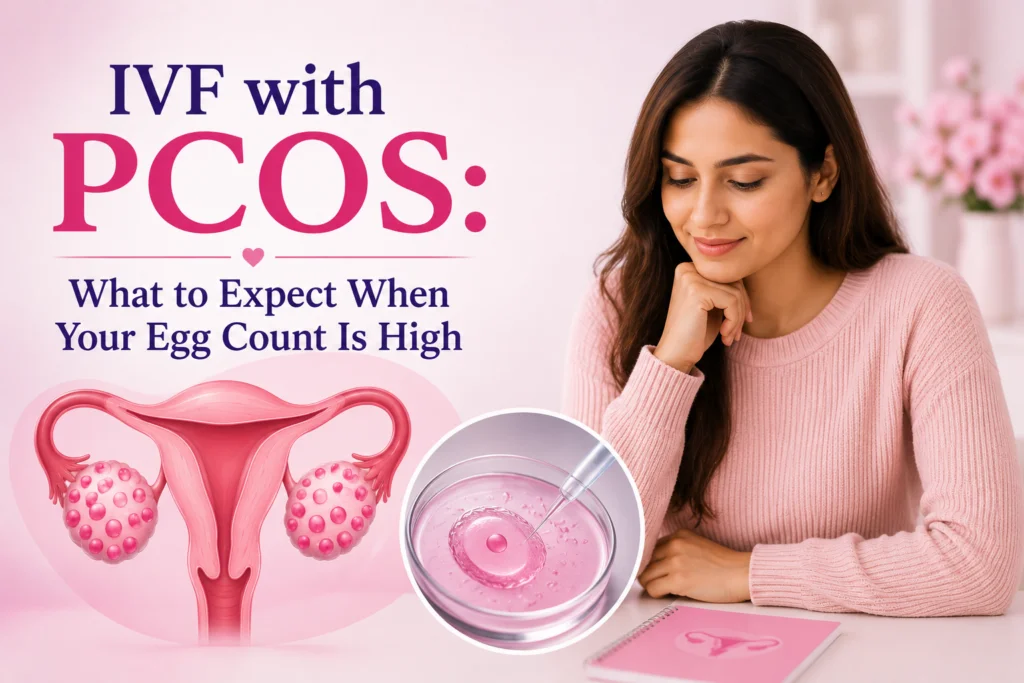
25 Jun IVF with PCOS: What to Expect When Your Egg Count Is High
Table of Contents
There is a paradox that many women with PCOS discover when they begin IVF. Their ovaries produce far more follicles than average sometimes 20, 30, or more and yet they still struggle to conceive. More eggs does not always mean an easier journey.
Understanding how IVF with PCOS works differently is one of the most important things you can do before starting treatment. This guide walks you through everything from protocol adjustments to OHSS risk and the freeze-all strategy explained by Dr. Shipra Gupta at Fertibless Clinic, South Delhi.
Why PCOS Changes the IVF Equation
Women with PCOS typically have a high antral follicle count (AFC) and elevated AMH (Anti-Müllerian Hormone) levels — both markers of a large egg reserve. This sounds advantageous, but it comes with a significant complication: PCOS ovaries are highly sensitive to FSH stimulation.
Quick Answer: IVF with PCOS requires a modified protocol to manage the risk of ovarian hyperstimulation syndrome (OHSS). Because PCOS ovaries respond strongly to fertility medications, doctors use lower stimulation doses, prefer the GnRH antagonist protocol, and often recommend a freeze-all strategy — delaying embryo transfer until the ovaries recover. IVF success rates in women with PCOS are generally favourable, particularly with a frozen embryo transfer (FET).
Understanding OHSS — The Key Risk for PCOS Patients
Ovarian Hyperstimulation Syndrome (OHSS) occurs when the ovaries over-respond to stimulation, becoming enlarged and leaking fluid into the abdomen.
Symptoms to watch for:
- Bloating and abdominal discomfort
- Nausea and vomiting
- Reduced urination
- Shortness of breath (in severe cases)
OHSS ranges from mild to severe. Women with PCOS are at significantly higher risk because of their high baseline follicle count. Choosing an experienced specialist who knows how to calibrate stimulation for PCOS patients is essential. According to NIH research, severe OHSS occurs in less than 1% of cases when a low-dose antagonist protocol is used correctly.
How IVF Protocols Are Adjusted for PCOS
- Lower starting FSH doses — to prevent over-stimulation
- GnRH antagonist protocol (preferred) — allows more precise control and enables a safer trigger shot
- GnRH agonist trigger (instead of hCG) — significantly reduces OHSS risk
- Metformin pre-treatment — in some patients, to reduce androgen levels and improve insulin sensitivity
- Frequent monitoring — scans and blood tests every 2–3 days to adjust medications in real time
Egg Quality vs Egg Quantity in PCOS
Retrieving many eggs does not automatically guarantee many good embryos. In PCOS, the large number of follicles often means a mix of mature and immature eggs. What matters most is how many eggs mature correctly, fertilise successfully, and develop into good-quality blastocysts by Day 5. It is not uncommon for a PCOS patient to retrieve 18–20 eggs and have 3–5 good-quality blastocysts — which is entirely normal and workable.
The Freeze-All Strategy — Why It Often Works Better for PCOS
In many PCOS IVF cycles, the recommendation is to freeze all viable embryos rather than do a fresh transfer in the same cycle. This approach allows:
- The ovaries to fully recover before a transfer
- The uterine lining to return to its natural state
- A Frozen Embryo Transfer (FET) in a subsequent cycle, when the body is ready
Research consistently shows that FET success rates in PCOS patients are strong — often matching or exceeding fresh transfer rates.
Expert Insight — Dr. Shipra Gupta, Fertibless Clinic
“PCOS patients often come to me worried that having many eggs means everything will go smoothly. I explain that our job is not just to retrieve as many eggs as possible — it is to retrieve the right eggs, fertilise them carefully, grow the best embryos, and transfer at the right time. For most PCOS patients, a freeze-all strategy followed by FET gives us the best outcome.”
— Dr. Shipra Gupta, IVF Specialist, Fertibless Clinic, New Delhi
Frequently Asked Questions
Can a woman with PCOS do IVF successfully?
Yes. IVF is highly effective for women with PCOS, particularly when the protocol is carefully designed. Many women with PCOS who did not conceive with ovulation induction or IUI go on to have successful pregnancies through IVF.
Is IVF the first option for PCOS?
No. IVF is typically considered after simpler options — lifestyle changes, ovulation induction, and IUI — have been tried. However, if there are other factors such as male infertility or blocked tubes, IVF may be recommended sooner.
What is the success rate of IVF with PCOS?
Data suggests that women with PCOS under 35 have live birth rates of approximately 50–51% per transfer when using their own eggs. Outcomes depend on egg quality, protocol, and individual health factors.
Does PCOS affect egg quality in IVF?
PCOS can influence oocyte maturation, but many women with PCOS produce good-quality embryos. A tailored stimulation protocol and careful laboratory management can optimise egg quality during the IVF process.

Dr. Shipra Gupta is a renowned obstetrician, gynaecologist, and infertility specialist, boasting over 17 years of invaluable clinical, teaching, and research experience. She has successfully performed more than 1200 cycles of IUI, IVF, natural cycle IVF, donor egg, and FET cycles. Dr. Gupta specializes in managing complex cases involving Advanced Maternal Age, PCO, Poor Ovarian Reserve, endometriosis, and unexplained infertility. Her expertise extends to treating recurrent IVF failures and male infertility.