
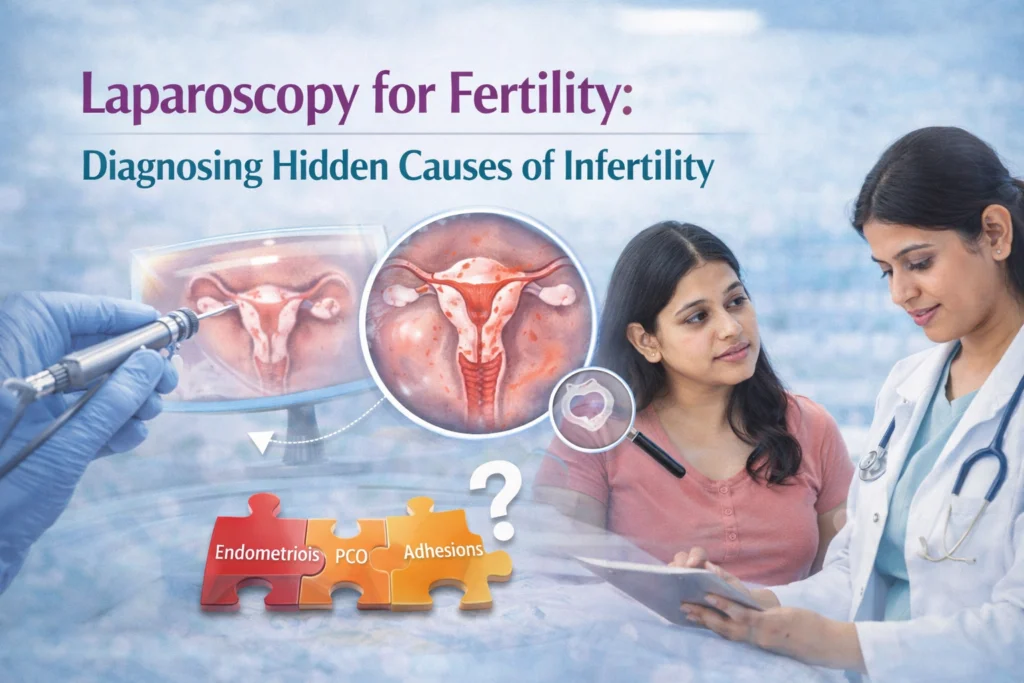
15 Mar Laparoscopy for Fertility: Diagnosing Hidden Causes of Infertility
Table of Contents
Introduction
Some causes of infertility are simply invisible to blood tests and ultrasounds. Endometriosis, pelvic adhesions, tubal blockages, and ovarian cysts can silently affect a woman’s reproductive organs — without any obvious symptoms. Laparoscopy for fertility is the most accurate way to find and treat these hidden conditions.
At Fertibless Clinic in Delhi, Dr. Shipra Gupta performs diagnostic and operative laparoscopy as part of a comprehensive fertility care protocol — helping couples finally understand why conception has been difficult, and what can be done about it.
What Is Laparoscopy?
Laparoscopy is a minimally invasive surgical procedure in which a thin, lighted camera (laparoscope) is inserted through a small incision near the navel. This allows the surgeon to view and operate on the reproductive organs — the uterus, fallopian tubes, ovaries, and surrounding pelvic structures — in real time, without large incisions.
Quick Answer: Laparoscopy is a keyhole surgical procedure that allows a fertility specialist to directly visualize the pelvic organs, diagnose conditions like endometriosis or blocked tubes that are invisible on scans, and treat them — often in the same procedure.
When Is Laparoscopy Recommended for Fertility?
Dr. Shipra Gupta may recommend laparoscopy for fertility when:
- Unexplained infertility — when all standard tests are normal but conception has not occurred
- Suspected endometriosis — especially with painful periods or pain during intercourse
- Blocked or damaged fallopian tubes — not fully confirmed by HSG
- Ovarian cysts or endometriomas — chocolate cysts on the ovaries
- Pelvic adhesions — scar tissue from previous infections, surgeries, or conditions
- Recurrent pregnancy loss — to rule out structural pelvic causes
- Prior pelvic infections — which may have caused tubal damage
If you have been trying to conceive for some time without success and standard tests show nothing, understanding when to see a fertility specialist is an important first step.
What Can Laparoscopy Diagnose and Treat?
| Condition | Impact on Fertility | Laparoscopic Treatment |
| Endometriosis | Inflammation, adhesions, egg quality | Excision or ablation of lesions |
| Blocked fallopian tubes | Prevents egg-sperm meeting | Tubal surgery or confirmed for IVF planning |
| Ovarian endometriomas | Affect egg quality and reserve | Cystectomy (cyst removal) |
| Pelvic adhesions | Distort anatomy | Adhesiolysis (release of scar tissue) |
| Fibroids (external) | Affect uterine blood supply | Myomectomy |
| Hydrosalpinx | Toxic fluid impairs IVF outcomes | Tube removal or clipping before IVF |
What to Expect During the Procedure
Laparoscopy is performed under general anesthesia, usually as a day surgery. Here is what happens:
- A small incision (about 1 cm) is made near the navel
- Carbon dioxide gas gently inflates the abdomen to create space for visualization
- The laparoscope is inserted; the pelvic organs are examined on a monitor
- Surgical instruments can be introduced through 1–2 additional small incisions to treat any conditions found
- The procedure typically takes 30–90 minutes depending on findings
- Most patients are discharged the same day, with full recovery in 3–7 days
The small incisions result in minimal scarring and a far shorter recovery than open surgery.
Does Laparoscopy Improve Fertility?
Yes — when a treatable condition is found. Research published on NIH PubMed shows that surgical correction of endometriosis and pelvic adhesions through laparoscopy can significantly improve natural conception rates and IVF outcomes.
However, laparoscopy is not a routine requirement for all infertility patients. For many couples, the appropriate investigations will point clearly toward IVF or IUI as the treatment path — without the need for surgery. A thorough fertility evaluation will determine whether laparoscopy is part of your diagnostic pathway.
Dr. Shipra Gupta, Fertibless Clinic: “Laparoscopy gives us a true window into the pelvis that no imaging test can replicate. When we find and treat what has been causing infertility — whether endometriosis, an adhesion, or a hydrosalpinx — the change in a couple’s outlook is remarkable.”
Conclusion
Laparoscopy for fertility is a precise and powerful diagnostic tool — one that can finally explain years of unexplained infertility and open a clear path forward. When combined with the right treatment plan, it can make a decisive difference.
If you are struggling to conceive and feel that something may have been missed, consult Dr. Shipra Gupta at Fertibless Clinic for a thorough evaluation and honest conversation about your options.
📞 +91 92899 36221 | 🌐 www.fertibless.com
Frequently Asked Questions
Is laparoscopy painful?
The procedure is performed under general anesthesia, so there is no pain during the surgery. Post-operatively, women may experience mild abdominal discomfort, shoulder pain (from residual gas), and fatigue for 2–5 days.
Will laparoscopy affect my ovarian reserve?
Laparoscopy itself does not reduce ovarian reserve. However, surgery on the ovaries — particularly for endometriomas — must be performed carefully to protect healthy ovarian tissue. This is why experience and surgical precision matter greatly.
How soon can I try to conceive after laparoscopy?
Most women can try to conceive naturally or proceed to fertility treatment within 4–8 weeks of laparoscopy, depending on what was found and treated. Your doctor will advise on the ideal timing for your specific situation.

Dr. Shipra Gupta is a renowned obstetrician, gynaecologist, and infertility specialist, boasting over 17 years of invaluable clinical, teaching, and research experience. She has successfully performed more than 1200 cycles of IUI, IVF, natural cycle IVF, donor egg, and FET cycles. Dr. Gupta specializes in managing complex cases involving Advanced Maternal Age, PCO, Poor Ovarian Reserve, endometriosis, and unexplained infertility. Her expertise extends to treating recurrent IVF failures and male infertility.