
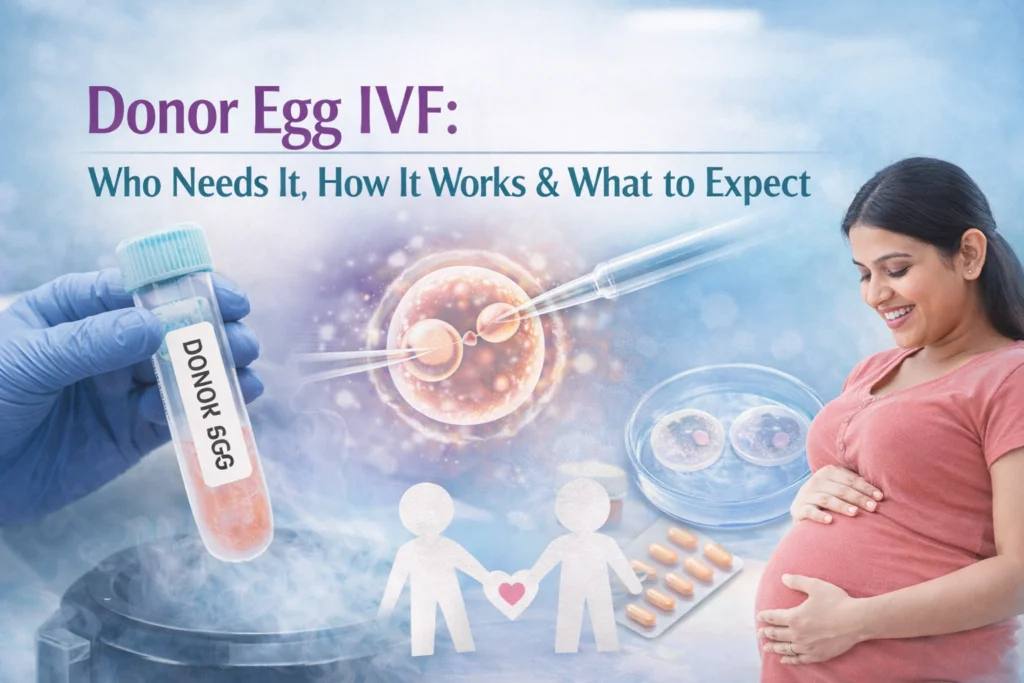
04 Mar Donor Egg IVF: Who Needs It, How It Works & What to Expect
Table of Contents
Introduction
For some women, the path to motherhood involves a profound and courageous choice — using eggs donated by another woman. Donor Egg IVF is not a last resort. It is a well-established, highly effective fertility treatment that has helped thousands of women carry and deliver their own babies, even when their own eggs are no longer able to support a healthy pregnancy.
At Fertibless Clinic in Delhi, Dr. Shipra Gupta offers Donor Egg IVF as part of a comprehensive and compassionate fertility care program — with full guidance, emotional support, and a transparent process from start to finish.
What Is Donor Egg IVF?
Donor Egg IVF is an IVF procedure in which eggs donated by a healthy, screened woman are fertilized with the intended father’s (or donor) sperm in a laboratory. The resulting embryo is then transferred into the intended mother’s uterus, where she carries the pregnancy.
Quick Answer: Donor Egg IVF uses eggs from a carefully screened donor, fertilized with the partner’s sperm, to create an embryo that is transferred into the intended mother’s womb. The baby is genetically related to the intended father and carried by the mother — making the bond deeply personal.
Who Is Donor Egg IVF Recommended For?
Donor Egg IVF may be the most appropriate path for women with:
- Premature ovarian insufficiency (POI) — very early menopause or ovarian failure
- Poor ovarian reserve — very low AMH or antral follicle count
- Recurrent IVF failure due to poor egg quality
- Advanced maternal age (typically 42+) where own-egg IVF is unlikely to succeed
- Genetic conditions that the woman does not wish to pass on
- Chemotherapy or radiation that has affected ovarian function
If you are unsure whether your ovarian reserve qualifies, a complete fertility evaluation — including an AMH blood test and antral follicle count — will provide the clarity you need. It is also worth reading our guide on fertility treatments for older couples if age is a primary concern.
The Donor Egg IVF Process: Step by Step
Step 1 — Donor Selection and Screening
Egg donors undergo rigorous medical, genetic, and psychological screening. Donors are matched based on physical characteristics, blood group, and other parameters discussed with the recipient couple. All donors at Fertibless are anonymous, as per Indian Council of Medical Research (ICMR) guidelines.
Step 2 — Synchronization
The donor’s ovulation cycle is synchronized with the recipient’s uterine preparation cycle, so the embryo is transferred at precisely the right time.
Step 3 — Donor Stimulation and Egg Retrieval
The donor undergoes ovarian stimulation and egg retrieval — identical to conventional IVF. Multiple eggs are typically retrieved, maximizing the chances of viable embryo development.
Step 4 — Fertilization and Embryo Culture
Retrieved eggs are fertilized with the intended father’s sperm (prepared through the sperm washing process). The resulting embryos are cultured for 3–5 days.
Step 5 — Uterine Preparation
The recipient’s uterine lining is prepared with estrogen and progesterone — similar to a Frozen Embryo Transfer cycle. Monitoring ultrasounds ensure the lining is ready.
Step 6 — Embryo Transfer and Pregnancy Test
The best-quality embryo is transferred into the recipient’s uterus. A blood pregnancy test follows 10–14 days later.
Success Rates of Donor Egg IVF
Donor Egg IVF consistently yields the highest success rates of any IVF treatment — primarily because eggs from young, healthy, screened donors are used, eliminating the age-related decline in egg quality.
| Recipient Age | Approximate Success Rate Per Transfer |
| Under 40 | 50% – 65% |
| 40 – 45 | 45% – 60% |
| Over 45 | 35% – 50% |
These rates are significantly higher than own-egg IVF for women over 40. Our blog on IVF success rates by age provides a helpful comparison.
Dr. Shipra Gupta, Fertibless Clinic: “Donor Egg IVF is one of the most powerful tools we have in fertility medicine. Many women who had given up hope of carrying a pregnancy have gone on to become mothers through this path. It requires courage — and it is absolutely worth it.”
Conclusion
Donor Egg IVF is a deeply meaningful and medically sound choice for women who want to experience pregnancy and motherhood when their own eggs are no longer viable. The bond you build carrying and delivering your child is uniquely and completely yours.
If you are considering this path, a consultation with Dr. Shipra Gupta at Fertibless Clinic will give you an honest, compassionate assessment of whether it is right for you.
📞 +91 92899 36221 | 🌐 www.fertibless.com
Frequently Asked Questions
Will the baby look like me if I use a donor egg?
The baby will be genetically related to the egg donor and the intended father. However, recent epigenetic research suggests that the uterine environment — including the mother’s hormones and nutrition — may influence how certain genes are expressed. Many donor egg babies share physical similarities with their birth mothers.
Is Donor Egg IVF legal in India?
Yes. Donor egg IVF is regulated in India under the ART (Regulation) Act 2021. At Fertibless, all procedures comply fully with Indian legal and ethical guidelines.
Can I keep Donor Egg IVF private?
Yes. Donor anonymity is maintained by law in India. The process at Fertibless is conducted with complete confidentiality and sensitivity.

Dr. Shipra Gupta is a renowned obstetrician, gynaecologist, and infertility specialist, boasting over 17 years of invaluable clinical, teaching, and research experience. She has successfully performed more than 1200 cycles of IUI, IVF, natural cycle IVF, donor egg, and FET cycles. Dr. Gupta specializes in managing complex cases involving Advanced Maternal Age, PCO, Poor Ovarian Reserve, endometriosis, and unexplained infertility. Her expertise extends to treating recurrent IVF failures and male infertility.