
22 Jan Male and Female Fertility Tests Explained: What’s Involved, When & Why
Fertility challenges can feel overwhelming especially when couples don’t know where to start. The first and most important step in understanding infertility is accurate fertility testing. Whether the concern lies with Male Fertility, Female Fertility, or both, the right tests help doctors identify the cause and plan effective treatment.
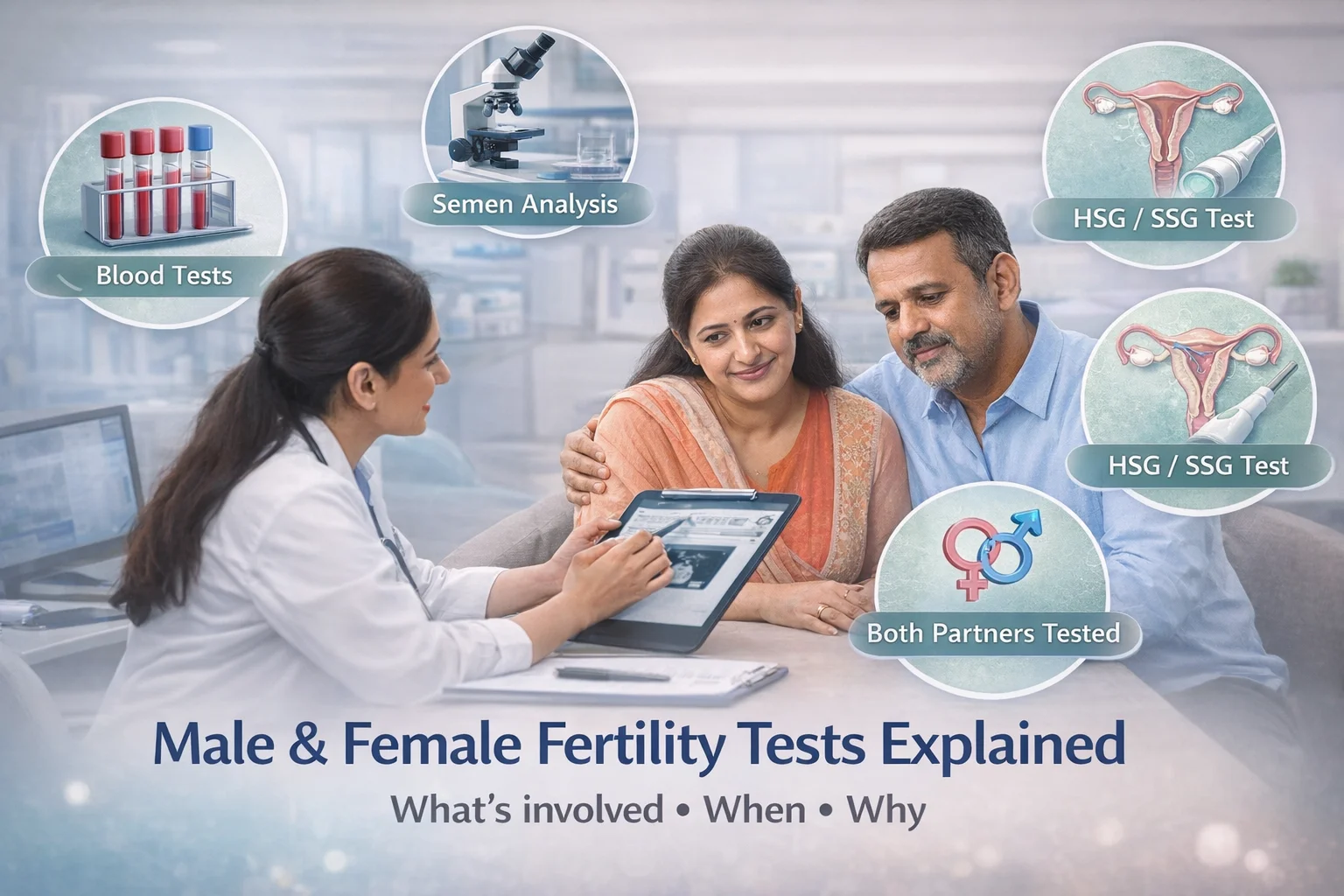
At experienced centers offering fertility care, diagnostic testing is always done for both partners, because infertility is a shared condition—not just a female issue. This guide explains the most common fertility tests, including Blood Test, Semen Analysis, and HSG & SSG Test, along with when and why each is recommended.
Why Fertility Testing Is Important
Fertility tests are not about labeling or blaming they are about clarity.
They help to:
• Identify the cause of infertility
• Avoid unnecessary or ineffective treatments
• Save time, emotional stress, and cost
• Create a personalized treatment plan
• Improve success rates of future fertility treatments
According to the World Health Organization, infertility affects millions of couples worldwide and should be evaluated as a medical condition involving both partners equally.
When Should Couples Consider Fertility Tests?
Couples should consider fertility testing if:
• Pregnancy has not occurred after 12 months of unprotected intercourse (under age 35)
• Pregnancy has not occurred after 6 months (woman over 35)
• Periods are irregular or absent
• There is a history of miscarriage or pelvic infection
• The male partner has a known medical or lifestyle risk
• There is known PCOS, endometriosis, or thyroid disorder
Early testing leads to early answers and better outcomes.
Female Fertility Tests Explained
Blood Test (Hormonal Evaluation)
A Blood Test is one of the most basic yet powerful fertility investigations for women.
It helps assess:
• Ovarian reserve (AMH)
• Ovulation (FSH, LH)
• Thyroid function (TSH)
• Prolactin levels
• Estrogen and progesterone balance
Why it matters:
Hormonal imbalance is a common cause of ovulation problems, irregular cycles, and implantation failure. Blood tests guide doctors in planning ovulation induction or IVF protocols.
When it’s done:
Usually on specific days of the menstrual cycle, depending on the hormone being tested.
Ultrasound & Ovulation Monitoring (often combined with blood tests)
Although not invasive, ultrasound plays a key role in evaluating:
• Ovarian reserve
• Follicle development
• Uterine lining
• Structural abnormalities
It is often paired with blood tests for accurate ovulation tracking.
HSG & SSG Test (Tubal Patency Tests)
The HSG & SSG Test checks whether the fallopian tubes are open and whether the uterus has a normal shape.
• HSG (Hysterosalpingography): Uses contrast dye and X-ray
• SSG (Sonosalpingography): Uses saline and ultrasound
Why it matters:
Blocked fallopian tubes prevent the egg and sperm from meeting—making natural conception impossible.
When it’s done:
After menstruation but before ovulation, to avoid disturbing a possible pregnancy.
Male Fertility Tests Explained
Semen Analysis
Semen Analysis is the most important test for evaluating Male Fertility.
It measures:
• Sperm count
• Sperm motility (movement)
• Sperm morphology (shape)
• Volume and liquefaction
Why it matters:
Nearly 40–50% of infertility cases involve male factors, either alone or combined with female issues.
When it’s done:
After 2–5 days of abstinence. If abnormal, the test may be repeated for confirmation.
Advanced Male Fertility Tests (If Needed)
If semen analysis is abnormal, further tests may include:
• Hormonal blood tests
• Sperm DNA fragmentation
• Genetic testing
• Ultrasound of testes or prostate
These tests help identify deeper causes and guide advanced fertility treatments.
What Happens After Fertility Tests?
Once results are available, your fertility specialist will:
• Explain findings in simple terms
• Identify whether the issue is male, female, combined, or unexplained
• Recommend lifestyle changes if required
• Suggest medical or assisted treatment options
• Create a personalized fertility roadmap
Testing is not the end it’s the beginning of informed care.
Fertility Treatments in Delhi: Why Diagnosis Comes First
At leading centers offering Fertility Treatments in Delhi, treatment decisions are always diagnosis-driven, not trial-and-error.
Accurate fertility tests help determine whether couples need:
• Lifestyle modification
• Ovulation induction
• IUI
• IVF or advanced ART
• Surgical correction
• Donor options (if required)
Clinics like Fertibless focus on ethical, personalized care ensuring couples receive only what they truly need.
Emotional Reassurance for Couples
Fertility testing can be emotionally stressful. Fear of results, guilt, or blame are common feelings but fertility issues are medical conditions, not personal failures.
Open communication, compassionate counseling, and timely testing often bring relief, not fear because clarity replaces uncertainty.
Conclusion
Understanding Male Fertility and Female Fertility begins with the right tests at the right time. Blood tests, semen analysis, and HSG & SSG tests provide critical insights that shape effective and ethical fertility treatment.
If you are struggling to conceive, don’t delay evaluation. Early fertility testing opens the door to the most suitable Fertility Treatments in Delhi, saving time, stress, and emotional strain while bringing you closer to informed hope.
Frequently Asked Questions
Are fertility tests painful?
Most fertility tests are simple and minimally uncomfortable. HSG or SSG may cause mild cramping but are generally well tolerated.
Should both partners get tested at the same time?
Yes. Fertility evaluation should always involve both partners to avoid delays and incomplete diagnosis.
How long does fertility testing take?
Basic testing usually takes one menstrual cycle. Advanced tests may take slightly longer.
Can lifestyle affect test results?
Yes. Smoking, alcohol, stress, obesity, and sleep patterns can impact both male and female fertility test results.
Do abnormal test results mean pregnancy is impossible?
No. Many fertility issues are treatable. Tests help identify the best treatment—not predict failure.

Dr. Shipra Gupta is a renowned obstetrician, gynaecologist, and infertility specialist, boasting over 17 years of invaluable clinical, teaching, and research experience. She has successfully performed more than 1200 cycles of IUI, IVF, natural cycle IVF, donor egg, and FET cycles. Dr. Gupta specializes in managing complex cases involving Advanced Maternal Age, PCO, Poor Ovarian Reserve, endometriosis, and unexplained infertility. Her expertise extends to treating recurrent IVF failures and male infertility.